
Chioma Vivian James
The quest to build stronger and more resilient social protection systems across Africa received a significant boost on Tuesday as the Nigeria Social Insurance Trust Fund (NSITF) and South Africa’s Rand Mutual Assurance (RMA) commenced discussions on a strategic partnership aimed at transforming workers’ compensation administration and workplace safety across the continent.
At the heart of the engagement was a shared vision: creating a more inclusive, responsive, and sustainable social security framework that protects workers, supports employers, and advances economic productivity in Africa’s two largest economies.
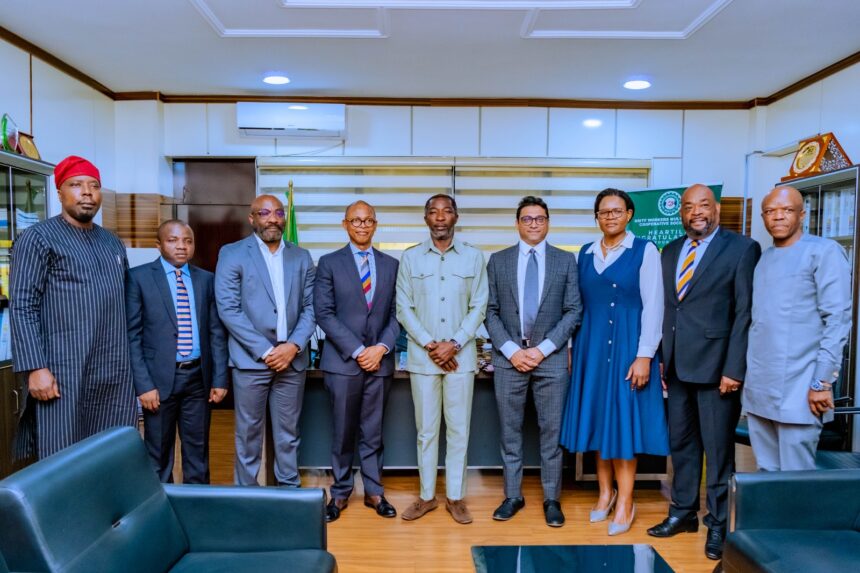
Hosting a high-powered delegation from Rand Mutual Assurance at the NSITF headquarters in Abuja, the Managing Director and Chief Executive Officer of NSITF, Barrister Oluwaseun Faleye, described the visit as more than a diplomatic courtesy. According to him, it represents the beginning of a long-term collaboration capable of redefining the future of social insurance and occupational injury compensation in Africa.

“Your visit marks the beginning of what we hope will evolve into a mutually beneficial and enduring relationship between our two organizations,” Faleye said. “It also highlights our shared commitment to advancing workers’ compensation, occupational safety and health, and social security administration on the African continent.”
The South African delegation was led by RMA Group Chief Executive Officer, Bilal Adam, whose organization has been a pillar of workers’ compensation administration for over a century.
Founded in 1894, Rand Mutual Assurance has grown from a specialized compensation scheme serving South Africa’s mining industry into one of Africa’s leading social insurance institutions, renowned for its integrated approach to prevention, rehabilitation, care, and value creation.leye acknowledged RMA’s remarkable evolution and enduring legacy, describing it as a model worthy of emulation.
“We are particularly delighted to receive an institution of such remarkable pedigree,” he noted. “Your transformation into a modern, purpose-driven social insurer with a strong emphasis on prevention, rehabilitation, care and shared value creation is both admirable and inspiring.”
A SHARED RESPONSIBILITY FOR AFRICA
As Africa continues to confront complex labour market realities—including changing work patterns, technological disruption, occupational health challenges, and evolving employment structures, Faleye emphasized the need for greater cooperation among institutions responsible for worker protection.
He argued that Nigeria and South Africa occupy strategic positions in shaping the future of social security on the continent and must therefore provide leadership by promoting innovation, knowledge exchange, and best practices.
“At NSITF, we recognize that the future of social protection lies in collaboration, innovation, and the exchange of experiences,” he said. “Nigeria and South Africa are two of Africa’s leading economies, and our institutions have a unique responsibility to champion best practices that will strengthen social protection systems throughout the continent.”
The proposed partnership is expected to facilitate extensive cooperation in areas such as digital transformation, claims administration, occupational health and safety, rehabilitation services, return-to-work programmes, capacity development, research, and policy formulation.
Industry observers note that such collaboration comes at a critical time when social insurance institutions globally are increasingly leveraging technology and data-driven solutions to improve service delivery, reduce claims processing delays, and expand coverage to vulnerable workers.
STRENGTHENING NIGERIA’S EMPLOYEES ‘ COMPENSATION SCHEME
Central to the discussions was NSITF’s renewed commitment to strengthening the Employees’ Compensation Scheme (ECS), one of Nigeria’s most important social protection interventions.
The scheme guarantees compensation and rehabilitation support for workers who suffer occupational injuries, diseases, disabilities, or death arising from workplace incidents. It also provides medical care and financial assistance to affected workers and their dependants while helping employers manage workplace liabilities through an organized compensation framework.
Faleye stressed that emerging workplace risks and the rapidly changing nature of work require continuous innovation and institutional reforms.
“The Employees’ Compensation Scheme remains a critical social protection mechanism in Nigeria,” he said. “It provides medical care, rehabilitation services, compensation benefits, and support to employees and their dependants in cases of work-related injury, disability, or death.”
He emphasized that the effectiveness of any compensation system depends on its ability to respond promptly to workers’ needs while promoting safer workplaces and encouraging rehabilitation and reintegration into productive employment.
According to him, NSITF is prioritizing key reforms aimed at modernizing the scheme and improving service delivery.
These include digitalization of operations, enhanced claims management processes, stronger occupational safety programmes, expanded rehabilitation initiatives, improved return-to-work strategies, capacity building, research, and policy development.
“These areas are essential to building a modern and responsive compensation system that protects workers while supporting employers and contributing to national productivity,” Faleye stated.
TOWARDS A NEW ERA OF COOPERATION
One of the major outcomes anticipated from the visit is the drafting and eventual ratification of a Memorandum of Understanding (MoU) between NSITF and RMA, which both organizations believe will serve as the foundation for long-term institutional cooperation.
Beyond formal agreements, both institutions are expected to participate in a series of technical sessions and knowledge-sharing engagements designed to identify practical areas of collaboration and mutual learning.
The discussions are expected to focus on innovative approaches to workplace injury management, prevention strategies, compensation administration, and social security governance.
For Faleye, the significance of the engagement extends beyond organizational interests.
He sees it as part of a broader effort to build stronger institutions, safer workplaces, and more resilient social protection systems capable of improving the lives of millions of African workers.
“As the world of work continues to evolve, institutions responsible for social protection must continue to innovate and adopt best practices that improve service delivery and strengthen public confidence,” he said.
Expressing optimism about the future of the partnership, he added: “Together, let us continue to build stronger institutions, safer workplaces, and a more inclusive and resilient social protection system for the benefit of workers across Africa.”
As both organizations begin charting a new path of collaboration, the partnership signals a growing recognition that Africa’s social protection challenges can best be addressed through collective action, shared expertise, and a commitment to putting workers’ welfare at the centre of economic development.