
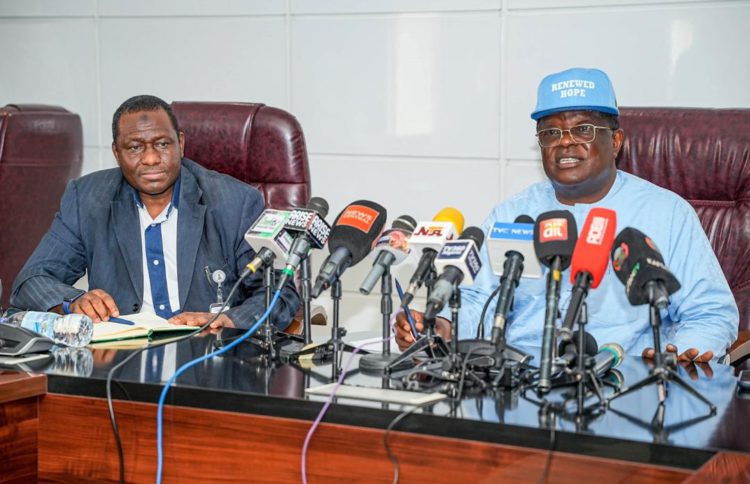
Umahi: Lagos-Calabar, Sokoto-Badagry, Calabar-Abuja and Akwanga-Maiduguri corridors to drive trade, agriculture, industrialisation, security and national integration
By Chioma Vivian James, Abuja
The Federal Government has unveiled an ambitious infrastructure strategy anchored on four major road corridors designed to reshape Nigeria’s transportation network, deepen economic integration and unlock new investment opportunities across the country’s six geopolitical zones.
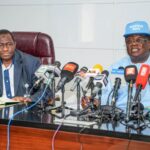
The Minister of Works, Engr. David Umahi, who disclosed this on Wednesday in Abuja while reviewing the administration’s infrastructure programme, described the four projects as more than conventional road construction schemes, saying they are being repositioned as economic arteries capable of connecting production centres, markets, ports and communities across Nigeria.
The four flagship corridors are the Lagos-Calabar Coastal Highway; Sokoto-Badagry Superhighway; Calabar-Ebonyi-Abuja Trans-Saharan Route; and Akwanga-Jos-Bauchi-Gombe-Biu-Maiduguri corridor.
According to Umahi, the projects are central to President Bola Tinubu’s infrastructure agenda and are expected to facilitate the movement of people, agricultural produce and industrial goods while stimulating investment, employment and regional development.
He said the Federal Government was deliberately moving away from the traditional approach of treating roads as isolated infrastructure projects to a broader model that integrates highways with railways, ports, industrial facilities, agriculture and emerging economic hubs.
Lagos-Calabar Coastal Highway Takes Centre Stage
Providing an update on the Lagos-Calabar Coastal Highway, Umahi said 47 kilometres of Section 1 had been completed, while approximately 55 kilometres of Section 2 had recorded substantial progress, putting the two sections under active development at about 102 kilometres.
He said pavement works on Section 2 were approaching completion, while flyovers, overpasses and underpasses were being constructed at technically challenging points.
The minister explained that portions of the alignment had been redesigned to accommodate existing and planned rail, road and industrial infrastructure, particularly around the Dangote Refinery and Lekki Deep Seaport axis.
He said the coastal highway was therefore being developed as part of an integrated transportation network rather than as a stand-alone road.
The Ondo axis, according to him, has presented significant engineering challenges, including difficult terrain, deep pits and problematic subsoil conditions.
These challenges have necessitated alignment adjustments, extensive filling and ground-improvement measures to enhance the durability and safety of the highway.
Umahi also disclosed that President Tinubu had directed that the continuation of the coastal highway through parts of the Niger Delta should be aligned with the existing East-West Road.
The decision, he explained, would also help address growing flood risks and the impact of climate change, with vulnerable sections of the East-West corridor to be raised to accommodate current and projected flood levels.
He identified the Benin City Bypass and other sections of the littoral corridor as critical components of efforts to reduce congestion and improve transportation across the South-South region.
Sokoto-Badagry Corridor to Open New Economic Frontiers
The second flagship project, the Sokoto-Badagry Superhighway, is being developed as a major economic corridor linking Ilelah in Sokoto State with Badagry in Lagos State.
Umahi said construction activities were at different stages across the Sokoto, Kebbi, Oyo, Ogun and Badagry axes, while work on sections in Niger and Kwara states was expected to commence soon.
Beyond its transportation function, the minister said the corridor was being designed to stimulate agriculture, manufacturing, tourism, housing and other investments by linking production centres with markets and major commercial gateways.
He added that the Federal Government was examining complementary investments that could transform the highway corridors into broader economic development zones.
Calabar-Abuja Corridor Targets North-South Integration
The Calabar-Ebonyi-Abuja corridor, described by the minister as the ancient Trans-Saharan Route, is another major component of the Federal Government’s connectivity strategy.
The project is expected to strengthen the link between Nigeria’s southern coastal economy and the northern part of the country while improving transportation across the South-South, South-East and North-Central zones.
Umahi said substantial progress had been made on initial sections, while additional sections had been approved to improve the corridor’s economic viability and attractiveness to potential financiers.
He said the expanded scope was intended to create a commercially sustainable transportation network rather than isolated road sections disconnected from the national economy.
Akwanga-Maiduguri Corridor Strengthens Northern Connectivity
The fourth legacy project, the Akwanga-Jos-Bauchi-Gombe-Biu-Maiduguri corridor, is being expanded from its existing single-carriageway configuration into a major northern transportation route.
Umahi disclosed that the scope had been extended to include the Jos-Ibi spur in Taraba State, with design and procurement processes already underway.
The corridor is expected to strengthen connectivity between the North-Central and North-East while facilitating trade and movement along one of the country’s important inland transportation routes.
Abuja-Kano Expressway, Benin-Asaba Rescue Plan
Beyond the four flagship corridors, the minister disclosed substantial progress on outstanding sections of the Abuja-Kaduna-Zaria-Kano Expressway.
He said all sections were substantially completed except the Jere-Kaduna section, which he said was progressing.
To improve safety along the 375-kilometre expressway, the ministry is also installing solar-powered lighting to enhance night visibility and security.
Umahi also announced an “Operation Rescue” intervention on the troubled Benin-Asaba Expressway, saying the Federal Government could not allow Nigerians to continue suffering because of unresolved contractual or concession-related challenges.
He disclosed that plans were being developed for comprehensive reconstruction of the road using Continuously Reinforced Concrete Pavement (CRCP).
The minister defended the increasing use of concrete pavement on strategic highways, arguing that properly designed concrete roads offer greater durability and could reduce recurrent maintenance costs over their operational lifespan.
Umahi Defends Lagos-Calabar Procurement
The minister also defended the procurement process for the Lagos-Calabar Coastal Highway, saying the ministry complied with the applicable procurement framework.
According to him, the ministry submitted its recommendation to the Bureau of Public Procurement (BPP), which reviewed the proposal before granting clearance, while the Federal Executive Council remained the final approving authority.
Umahi said contractor rates were subjected to market scrutiny, stressing that indigenous and foreign contractors were assessed using the same pricing and evaluation principles.
“We put everybody on the same platform,” he said, adding that rates considered excessive by procurement authorities were reviewed.
South-East ‘Fully Reintegrated’ Into Federal Infrastructure Plan
The minister also placed particular emphasis on infrastructure development in the South-East, insisting that the region was being reintegrated into the Federal Government’s national infrastructure programme.
He cited the Second Niger Bridge, rehabilitation of the First Niger Bridge, major bypasses and other federal road projects as evidence of the administration’s intervention in the region.
“We can’t continue to live in denial. What we have been crying for is being given. The people of the South-East are being fully reintegrated into the national infrastructure development plan,” Umahi said.
He maintained that infrastructure development should be assessed from the standpoint of national integration rather than regional politics.
Government Warns Non-Performing Contractors
Umahi warned contractors who receive mobilisation or project funds without deploying the money to construction sites that the government would take steps to recover public funds where performance was inadequate.
He said accountability, performance and value for money remained central to the administration’s infrastructure delivery agenda.
On inherited projects under the Tax Credit Scheme, the minister said the government was taking steps to address projects affected by financing difficulties involving private-sector partners.
He also disclosed plans to strengthen traffic management and protect the First Niger Bridge from avoidable deterioration through the deployment of traffic management infrastructure, CCTV cameras and other security measures at the Onitsha and Asaba approaches.
According to him, bridges are primarily designed to withstand dynamic loads, making prolonged congestion and stationary heavy vehicles a potential structural concern.
Government Lists Completed, Advanced Projects
The minister listed several projects as completed or ready for commissioning, including the first section of the Lagos-Calabar Coastal Highway, Kwanar Danja-Hadejia Road, Kaduna-Pambeguwa Road, Lafia Bypass and Bodo-Bonny Road with bridges across the Opobo Channel.
Other projects cited included the Gombe-Potiskum rehabilitation project, sections of the Azare Road linking Jigawa and Bauchi, the five-span Ampoha Bridge, the 23-kilometre, 23-span flyover at the Ekpoma-Benin axis and a three-span, 75-metre dualised bridge.
He added that sections of the Lagos-Badagry, Lagos-Ibadan and Lagos-Shagamu-Ore corridors had either been completed or reached advanced stages.
Umahi said the ministry was updating its compendium of completed and ongoing projects and would make it available to the public.
‘We Don’t Start What We Will Not Finish’
On financing, the minister assured Nigerians that mechanisms had been established to fund the major legacy projects through completion.
He said significant portions of the projects had already been funded, while loan-financing arrangements were being implemented for outstanding components.
The government, he stressed, would not deliberately commence projects without credible funding arrangements.
“We don’t start what we will not finish. And we will not finish what we have not started,” Umahi said.
Ultimately, the minister maintained that the four legacy corridors represent a long-term national investment aimed at integrating Nigeria’s regions, expanding trade, strengthening security, stimulating agriculture and industrialisation, reducing transportation bottlenecks and creating new economic opportunities.
The Director Overseeing the Office of the Permanent Secretary, Mohammed Aminu Ahmed, FCNA, thanked the media for its continued engagement with the Ministry and urged journalists to sustain constructive scrutiny of the government’s infrastructure programme.