
BHCPF Funding Rises by ₦7.88bn as FG Targets 13,521 Primary Healthcare Centres, Strengthens Accountability and Expands Access for Vulnerable Nigerians
Chioma Vivian James ABUJA
The Federal Government has approved ₦40.76 billion for the third quarter of 2026 under the Basic Health Care Provision Fund (BHCPF), alongside plans to extend health insurance coverage to approximately 90,000 inmates in correctional facilities nationwide.
The decisions underscore the government’s renewed push to strengthen primary healthcare financing, expand access to essential medical services and ensure that vulnerable Nigerians are not excluded from the nation’s healthcare system.
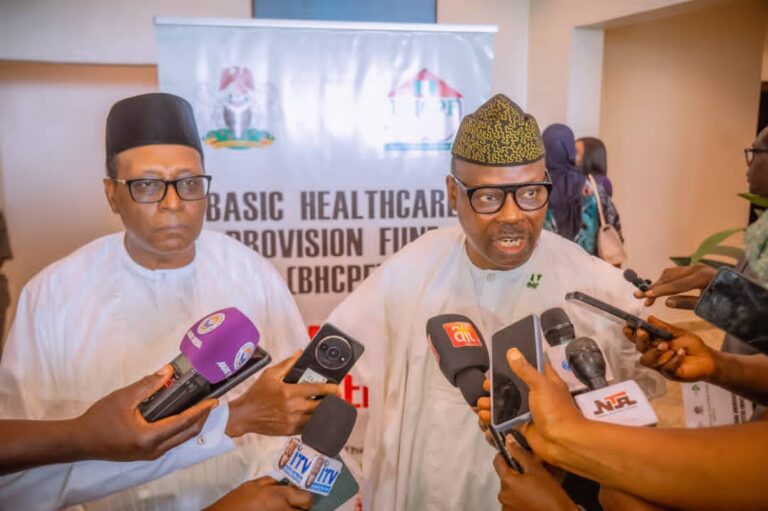
The Coordinating Minister of Health and Social Welfare, Prof. Muhammad Ali Pate, disclosed this on Wednesday in Abuja after the 16th meeting of the Ministerial Oversight Committee (MOC) on the BHCPF.
Pate said the approved sum of ₦40,758,116,943.50 represented an increase of approximately ₦7.88 billion over the ₦32.88 billion allocated in the preceding quarter.
He explained that the measures aligned with the Federal Government’s commitment to delivering quality, affordable and accessible healthcare, particularly to poor, vulnerable and underserved populations, in line with the Renewed Hope Agenda and the Nigeria Health Sector Renewal Investment Initiative.
NHIA, NPHCDA Get Lion’s Share
Under the approved allocation, the National Health Insurance Authority (NHIA) will receive ₦19.87 billion, representing 48.75 per cent of the fund, while the National Primary Health Care Development Agency (NPHCDA) will receive ₦18.34 billion, representing 45 per cent.
The Emergency Medical Treatment gateway is allocated ₦2.04 billion, representing five per cent, while the Nigeria Centre for Disease Control and Prevention (NCDC) will receive ₦509.48 million, accounting for 1.25 per cent.
The minister also disclosed that monthly statutory releases into the fund had increased progressively from approximately ₦8.95 billion to ₦13.08 billion and subsequently to ₦20.43 billion.
However, he stressed that increased funding must translate into timely disbursement, transparent financial management and measurable improvements in healthcare delivery.
According to him, the ultimate objective is to ensure that increased public investment produces tangible benefits for Nigerians, particularly those who struggle to afford essential medical services.
90,000 Inmates to Benefit from Health Insurance
In a significant move to expand healthcare access to underserved populations, the committee approved the extension of health insurance coverage to approximately 90,000 inmates in correctional facilities across the country.
The initiative, to be implemented through the NHIA, followed a request from the Nigerian Correctional Service.
The implementation will be guided by regular reporting and appropriate safeguards, while inmates already enrolled in state health insurance schemes will be excluded to prevent duplication of coverage.
The initiative represents an important step towards improving access to essential healthcare among people in correctional facilities, who may otherwise face considerable barriers to obtaining medical attention.
5,212 More Primary Healthcare Centres to Benefit
The Federal Government is also set to expand BHCPF support from 8,309 to 13,521 primary healthcare facilities nationwide, adding 5,212 facilities across the 36 states and the Federal Capital Territory.
The expansion is expected to strengthen healthcare delivery at the grassroots, where primary healthcare centres serve as the first point of contact for many Nigerians seeking medical attention.
The committee further considered a phased financing model to support states in recruiting and progressively absorbing Skilled Birth Attendants and Community-Based Health Workers into their healthcare systems.
The proposed arrangement is aimed at strengthening the health workforce and improving access to maternal, newborn and community-level healthcare services.
New Procurement Strategy to Improve Access to Medicines
To address challenges associated with access to essential medicines and medical commodities, the committee approved the operationalisation of changes to the NPHCDA gateway, including pooled procurement through MEDIPOOL, Nigeria’s national Group Purchasing Organisation.
The arrangement is expected to improve transparency, strengthen quality assurance and ensure a more reliable supply of medical commodities.
It will also incorporate value-for-money safeguards, pricing benchmarks and supply-chain monitoring to promote efficiency and accountability in the procurement and distribution of essential health products.
Committee Moves Against Delayed Fund Releases
Concerned about delays in the movement of healthcare funds from the various gateways through states and local government areas to frontline health facilities, the MOC resolved to establish a subcommittee to investigate the bottlenecks.
The subcommittee is expected to submit its report within six weeks, with the findings intended to guide measures for improving the timely release and utilisation of funds.
The committee also directed that letters be sent to state governors outlining the financial requirements needed by the NCDC to respond effectively to disease outbreaks.
The move is expected to reinforce preparedness and improve coordination in responding to public health emergencies.
FG, ICPC Strengthen Financial Accountability
On financial accountability, Pate disclosed that the Federal Government was collaborating with the Independent Corrupt Practices and Other Related Offences Commission (ICPC) to track health sector funds and prevent their misapplication.
He warned that the government would not tolerate the diversion or misuse of resources intended to improve healthcare access for ordinary Nigerians.
“Government will not condone any act that is capable of depriving ordinary Nigerians of the health goods these funds are meant for,” the minister said.
The emphasis on accountability comes as the government seeks to ensure that increased funding translates into improved services, better-equipped facilities and greater access to essential healthcare.
Pate Urges States to Honour Funding Obligations
The minister commended the Katsina State Governor for releasing ₦243 million to the State Health Insurance Agency to expand BHCPF coverage.
He also urged other state governments and the FCT administration to fulfil their counterpart funding obligations under the National Health Act, 2014.
The call highlights the importance of collaboration between federal and subnational governments in sustaining healthcare financing and ensuring that available resources reach intended beneficiaries.
As the government expands the reach of the BHCPF, the focus will increasingly be on translating larger allocations into functioning primary healthcare facilities, accessible medicines, adequate staffing and effective health insurance coverage.
Ultimately, the success of the initiative will be measured not merely by the amount approved, but by the extent to which ordinary Nigerians, particularly vulnerable households and underserved communities, experience meaningful improvements in healthcare access and quality.