

Chioma Vivian James
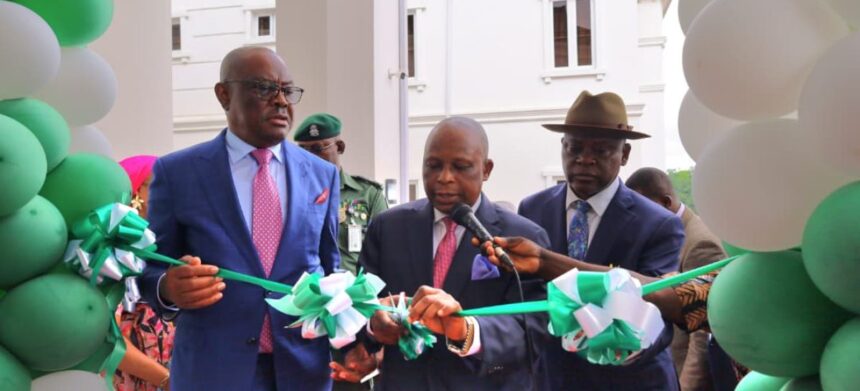
President Bola Ahmed Tinubu has reaffirmed his administration’s commitment to strengthening the rule of law and rebuilding public confidence in Nigeria’s institutions with the commissioning of 20 modern residential quarters for judges of the Federal Capital Territory (FCT) High Court in Katampe District, Abuja.
The landmark project, commissioned on Wednesday as part of activities marking the third anniversary of the Tinubu administration, underscores the Federal Government’s determination to enhance judicial welfare, security and institutional efficiency. The initiative also reflects the collaborative efforts of President Tinubu and the Minister of the Federal Capital Territory (FCT), Barrister Nyesom Wike, in advancing reforms aimed at strengthening the nation’s justice sector.
 Represented by the Attorney-General of the Federation and Minister of Justice, Prince Lateef Olasunkanmi Fagbemi (SAN), President Tinubu described the housing development as a strategic investment in democracy, judicial independence and the effective administration of justice.
“When we launched the Renewed Hope Agenda three years ago, we made a commitment to restore institutional trust, strengthen national security and ensure that the rule of law remains sacrosanct. The commissioning of these 20 residential quarters for FCT High Court judges is another concrete step toward fulfilling that promise,” the President stated.
According to him, the project goes beyond the provision of accommodation. It symbolizes the administration’s resolve to create an enabling environment where judicial officers can perform their constitutional duties effectively, independently and without unnecessary distractions.
The President highlighted a series of interventions already undertaken to improve judicial infrastructure and welfare nationwide. These include the commissioning of 10 residential units each for judges of the Court of Appeal and the Federal High Court, the first phase of accommodation for staff of the Nigerian Law School, and ongoing construction of residential quarters for judges of the National Industrial Court and the Code of Conduct Tribunal.
Responding to concerns that the provision of official residences could compromise judicial independence, Tinubu dismissed such claims, insisting that the initiative is strictly a welfare and infrastructure intervention.
“The judiciary’s budget remains intact and fully respected. These projects are not designed to influence judicial decisions but to provide comfort, security and dignity for judicial officers. A judge who is secure and adequately accommodated is better positioned to uphold justice without fear or distraction,” he said.
The President further commended FCT Minister Nyesom Wike for driving what he described as transformative infrastructure development across the Federal Capital Territory. He noted that the numerous projects executed by the FCTA demonstrate a practical commitment to strengthening institutions and improving public service delivery.
Speaking at the ceremony, Wike disclosed that the housing project was executed in line with President Tinubu’s directive to improve the welfare and security of judicial officers as a cornerstone of judicial independence.
“You cannot genuinely advocate for an independent judiciary without paying attention to the welfare and security of judicial officers. From the outset, President Tinubu made it clear that concrete measures must be taken, and this project is part of that commitment,” Wike said.
The minister revealed that three additional court complexes for judges and magistrates would be completed and handed over before the end of the year. He also announced plans to construct another 20 housing units for FCT High Court judges before the expiration of President Tinubu’s first term in office.
Addressing criticism surrounding land allocation in Katampe, Wike explained that the area was reclaimed from Julius Berger in the overriding public interest after remaining undeveloped for several years due to inadequate infrastructure.
“When government is determined to serve the people and do what is right, criticism is inevitable. However, our focus remains on delivering projects that positively impact the lives of Nigerians,” he stated.
The FCT Minister further hinted that the administration would seek presidential approval for an owner-occupier arrangement that would enable judges residing in the newly commissioned quarters to eventually acquire the properties.
Earlier, the Chief Judge of the FCT High Court, Justice Husseini Baba-Yusuf, described the housing project as a landmark investment in judicial welfare, security and institutional independence.
“The welfare of judicial officers is not a privilege; it is an institutional necessity. Adequate housing enhances productivity, guarantees security, promotes stability and preserves the dignity that should accompany judicial office,” he said.
Justice Baba-Yusuf commended President Tinubu and the FCT Administration for their support and appealed for similar interventions for the FCT Sharia Court of Appeal and the Customary Court of Appeal.
The commissioning of the judges’ quarters marked the 26th consecutive project inaugurated by the FCTA as part of activities commemorating the third anniversary of the Tinubu administration. Beyond the physical infrastructure, the project stands as a powerful statement of the government’s determination to strengthen the judiciary, uphold the rule of law and build public confidence in Nigeria’s democratic institutions.
For many observers, the initiative represents more than the construction of residential buildings; it reflects a broader vision of a justice system empowered by security, dignity and independence—an essential foundation for national development and democratic stability.