

By Chioma Vivian James
The National Office for Technology Acquisition and Promotion (NOTAP) and the Nigeria Union of Journalists (NUJ), FCT Council, have strengthened collaboration aimed at transforming academic research findings into commercially viable products and services capable of boosting national revenue, creating jobs and accelerating Nigeria’s industrial development.
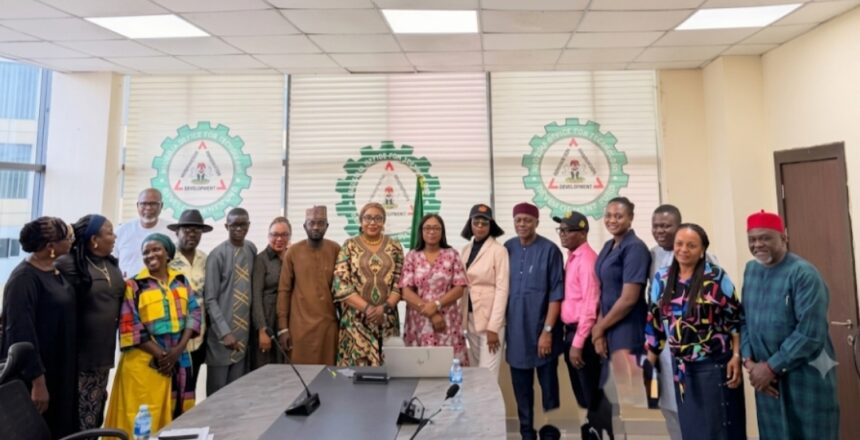
The commitment was reaffirmed by the Director-General of NOTAP, Dr. Obiageli Amadiobi, during a courtesy visit by the leadership of the NUJ FCT Council to the agency’s headquarters in Abuja. The engagement focused on building a strategic partnership to promote indigenous innovation, technology transfer, intellectual property awareness and effective public communication of science and technology initiatives.
A major highlight of the meeting was the announcement of the forthcoming National Technology and Innovation Summit scheduled to hold at the Civic Centre, Lagos, on October 7 and 8, 2026. According to Dr. Amadiobi, the summit will serve as a national platform bringing together researchers, innovators, manufacturers, investors, financial institutions and the Bank of Industry to facilitate the commercialisation of research outputs through strategic matchmaking and investment opportunities.
She explained that many groundbreaking innovations developed in Nigerian universities and research institutions often fail to reach the market due to inadequate funding and limited industry connections. The summit, she noted, is designed to bridge this gap by connecting researchers directly with investors and industry players capable of transforming ideas into profitable enterprises that contribute meaningfully to economic growth.
“The goal is to ensure that research does not end on library shelves but becomes products, services and technologies that solve real problems, generate employment and increase national revenue,” she stated.
Dr. Amadiobi emphasized that the initiative aligns with NOTAP’s core mandate of promoting technology acquisition, encouraging indigenous innovation and ensuring that research outcomes are translated into commercially sustainable ventures.
She also underscored the vital role of the media in advancing Nigeria’s innovation ecosystem, noting that journalists are indispensable partners in shaping public understanding of science, technology and innovation.
“Effective communication of technological advancements is essential for national development. Journalists have the power to educate the public, inspire confidence in local innovations and encourage wider participation in technology-driven growth,” she said.
Addressing technology transfer and local capacity development, the NOTAP Director-General highlighted the agency’s efforts to domesticate and adapt foreign technologies to meet Nigeria’s developmental needs. She observed that for decades, Nigeria functioned largely as a consumer of imported technologies due to limited local expertise.
However, she noted that the implementation of NOTAP’s Local Vendor Policy has significantly altered that narrative, particularly within the Information and Communications Technology (ICT) sector. The policy requires Original Equipment Manufacturers (OEMs) to invest in training Nigerians and developing local capacity, resulting in the emergence of skilled indigenous software developers and ICT professionals making significant contributions both nationally and internationally.
Building on these successes, NOTAP plans to replicate similar achievements across manufacturing, engineering and other strategic sectors through targeted technology transfer programmes, skills development initiatives and increased local participation.
In furtherance of its innovation agenda, the agency is developing a state-of-the-art Technology and Innovation Hub that will provide practical demonstrations of emerging technologies, including Artificial Intelligence (AI). The facility is expected to make technology learning more interactive, accessible and industry-oriented.
Dr. Amadiobi revealed that NOTAP is already collaborating with leading technology companies such as Huawei, MTN and Airtel to strengthen staff capacity and enhance Nigeria’s ability to assess, adapt and effectively utilize imported technologies.
On youth development, she unveiled the National Outsourcing Value Acceleration (NOVA) Programme, a strategic initiative designed to equip young Nigerians with industry-relevant skills through simulation-based training and practical field exposure. The programme will focus on key sectors including maritime, engineering and manufacturing, helping bridge the nation’s skills gap while positioning participants for opportunities in the global workforce.
She further disclosed that several state governments, including Niger State, have expressed interest in partnering with NOTAP to establish innovation centres that will stimulate entrepreneurship, technological advancement and economic development at the subnational level.
Speaking during the visit, Chairman of the NUJ FCT Council, Comrade Grace Ike, described NOTAP as a pivotal institution driving Nigeria’s technological transformation through its work in technology acquisition, technology transfer, intellectual property protection and the promotion of indigenous innovation.
“The future of Nigeria depends on strong partnerships between institutions that inform, innovate and inspire. NOTAP occupies a strategic position in shaping Nigeria’s technological future, and its contributions are critical to national growth and competitiveness,” she said.
Comrade Ike disclosed that her study of the agency’s programmes before the visit left her impressed by NOTAP’s achievements and impact on the country’s technology ecosystem.
“You are helping to build a Nigeria that not only consumes ideas but creates them. As journalists, we recognize that technology and communication are inseparable. The media’s responsibility extends beyond reporting innovation to explaining it, amplifying it and connecting it with the people,” she added.
She stressed that the partnership between NUJ and NOTAP would focus on public enlightenment, innovation advocacy, capacity building and national development. According to her, the media can play a significant role in increasing public awareness of technology policies, promoting indigenous innovations and showcasing success stories emerging from Nigeria’s research and innovation landscape.
The NUJ Chairman also proposed regular capacity-building programmes for journalists covering science, technology and innovation, noting that specialized training would enhance reporting on intellectual property rights, technology transfer, research commercialisation and innovation policy.
She further advocated joint public awareness campaigns on intellectual property protection, patent registration and technology transfer targeted at inventors, researchers, startups and technology entrepreneurs.
The collaboration between NOTAP and NUJ signals a renewed commitment to building a knowledge-driven economy where innovation thrives, research translates into wealth creation and technology serves as a catalyst for sustainable national development.