

By Chioma Vivian James
A silent but dangerous health crisis is unfolding across Nigeria, threatening decades of medical progress and turning once-treatable infections into potentially deadly illnesses.
The threat is antimicrobial resistance (AMR)—a growing global emergency often described as a “silent pandemic.” Health experts warn that the misuse and overuse of antibiotics are fueling drug-resistant infections, leaving doctors with fewer treatment options and putting millions at risk.
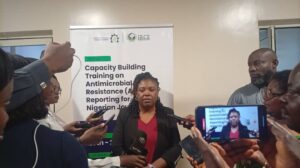
The warning came during a two-day capacity-building workshop for health journalists on AMR reporting in Abuja, organized by the Institute of Human Virology Nigeria (IHVN) in collaboration with the Nigeria AMR Media Alliance (NAMA) under the Antimicrobial Stewardship Education Program (A-STEP).
 A CRISIS HIDING IN PLAIN SIGHT
Representing the Chief Executive Officer of IHVN, Dr. Patrick Dakum, Senior Program Manager for Research and Evaluation and Chair of the IHVN Ethics Committee, Dr. Nnakelu Eriobu, described AMR as one of Nigeria’s most serious yet least understood public health threats.
He explained that antimicrobial resistance occurs when bacteria, viruses, fungi, and parasites evolve to resist medicines that once killed them, making infections harder and more expensive to treat.
 “Many Nigerians may already be experiencing the effects of antimicrobial resistance without realizing it,” he said, noting that treatment failures are often mistaken for a need for stronger drugs.
Eriobu warned that AMR affects not only patients but also families, healthcare systems, and the economy through prolonged illness, rising medical costs, reduced productivity, and increased deaths.
“This is not simply a healthcare problem,” he stressed. “It is a social, economic and development challenge that requires urgent attention.
NIGERIA’S GROWING BURDEN
Providing a global perspective, Dr. Giorgia Sulis, Associate Professor, Canada Research Chair in Communicable Disease Epidemiology, and Co-Principal Investigator of A-STEP, said Nigeria ranks 20th among 204 countries globally for AMR-related deaths and seventh in sub-Saharan Africa.
She explained that microbes develop resistance when they survive antibiotic exposure and gradually evolve mechanisms that enable them to withstand treatment.
“The more antibiotics are used, the greater the pressure placed on microbial populations,” she said. “This allows resistant organisms to survive, multiply and spread.”
According to Sulis, misuse of antibiotics in humans, livestock production, and agriculture is accelerating the crisis.
While commending Nigeria for launching its National Action Plan on AMR in 2017, she noted that weak surveillance systems mean many resistant infections remain undetected and underreported.
THE SLOW-MOVING PANDEMIC
Unlike outbreaks that trigger immediate public concern, AMR spreads quietly.
“AMR is a difficult story to tell because it is a slow-moving crisis,” Sulis said. “It does not create one dramatic event that captures public attention, yet it is steadily growing in the background.”
She urged journalists to help make the issue visible through accurate, evidence-based reporting and careful interpretation of scientific data.
THE SELF-MEDICATION PROBLEM
A major driver of AMR in Nigeria is widespread self-medication.
Dr. Charity Oga-Omenka, Assistant Professor at the University of Waterloo’s School of Public Health Sciences and Principal Investigator of the A-STEP Project, revealed that studies suggest nearly 70 percent of Nigerians obtain antibiotics without a prescription.
“The public needs to understand that demanding antibiotics without a prescription may be doing more harm than good,” she said.
 She noted that many Nigerians assume symptoms such as fever automatically indicate malaria or bacterial infections, leading to inappropriate antibiotic use and treatment failure.
DIAGNOSIS BEFORE DRUGS
Oga-Omenka emphasized that proper diagnosis is one of the strongest defenses against AMR.
“You cannot diagnose yourself with malaria or any other infection simply based on symptoms,” she said, stressing the importance of laboratory testing and professional medical consultation.
Although diagnostic tests may be costly, she argued that failed treatments and prolonged illnesses resulting from self-medication often create even greater financial burdens.
“Investing in proper diagnosis ultimately saves lives and reduces healthcare costs,” she added.
A ONE HEALTH CHALLENGE
Experts stressed that AMR extends beyond hospitals and clinics, affecting human health, animal health, agriculture, food production, and the environment.
According to Dr. Eriobu , the use of antibiotics in livestock production, environmental contamination, poor sanitation, and improper disposal of medicines all contribute to the spread of resistant organisms.
“The solution will require action from multiple directions,” he said, noting that healthcare professionals, farmers, regulators, policymakers, and the public all have vital roles to play.
Traditional Medicine and Regulation
The workshop also examined the role of traditional medicine.
While acknowledging its historical contributions, Oga-Omenka called for stronger scientific validation, quality control, and regulation of herbal products.
She expressed concern that some herbal preparations may contain undisclosed pharmaceutical ingredients, including antibiotics, potentially contributing to resistance.
“Traditional medicine has tremendous potential,” she said, “but there must be proper regulation, standardization and scientific evaluation.”
WEAK ENFORCEMENT , EASY ACCESS
Despite laws restricting antibiotics to prescription-only use, experts observed that they remain widely available through pharmacies, patent medicine stores, and informal vendors.
Participants called for stronger enforcement, improved monitoring, and stricter regulation of antibiotic sales to prevent further misuse.
WHY THE MEDIA MATTERS
A recurring theme throughout the workshop was the critical role of journalists in translating scientific evidence into public understanding.
“You can have all the science,” Eriobu said, “but if journalists are not carrying the information and disseminating it to the public, then the science is of little value.”
Similarly, Ojoma Akor, Founder of the Nigeria AMR Media Alliance (NAMA), urged journalists to embrace evidence-based reporting that promotes accountability, encourages behavioural change, and supports public health interventions.
THE COST OF INACTION
Globally, AMR contributes to millions of deaths annually and is considered one of the greatest threats to modern medicine.
Without effective antibiotics, routine surgeries, childbirth, cancer treatment, organ transplantation, and the treatment of common infections could become significantly more dangerous.
 Experts warned that continued antibiotic misuse, weak regulation, poor awareness, and inadequate healthcare access could accelerate the spread of resistant infections and further strain Nigeria’s healthcare system.
A RACE AGAINST TIME
Despite the scale of the challenge, experts insist that AMR is not inevitable.
Through stronger regulation, improved surveillance, responsible antibiotic use, better diagnostics, public education, and coordinated action across sectors, Nigeria can slow the spread of drug-resistant infections and preserve life-saving medicines.
The message from Abuja was clear: antibiotics are a precious and finite resource. Protecting them requires action from governments, healthcare professionals, researchers, regulators, farmers, journalists, and citizens alike.
The silent pandemic is already here. Whether it becomes a national catastrophe depends on the actions taken today.