

By Chioma Vivian James
The Federal Government has moved a step closer to the establishment of state police, with deliberations now focused on constitutional amendments that would provide the legal foundation for a decentralized policing structure across the country.
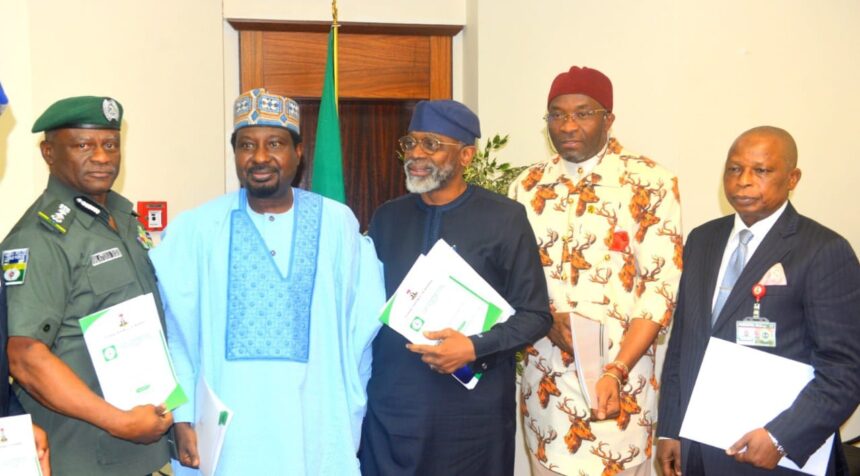
Chief of Staff to the President, Hon. Femi Gbajabiamila, disclosed this after a high-level stakeholders’ meeting on security sector reforms, revealing that discussions had progressed significantly and that details of the proposed constitutional amendment would soon be made public.
“Hopefully, the amendment will come shortly, and the details of the amendment will come after that,” Gbajabiamila stated.
According to him, attention has now shifted from the broader debate on the desirability of state police to the practical and legal steps required for its implementation.
“Right now, what we are looking at is the constitutional amendment itself, and then the enabling law would follow thereafter. That is what we have been deliberating on in the last couple of hours,” he explained.
Gbajabiamila noted that there is growing consensus among critical stakeholders across the country in support of the initiative, stressing that discussions are no longer centered on whether Nigeria should adopt state policing but rather on establishing the appropriate constitutional, legal and institutional safeguards that would guarantee its effectiveness and accountability.
The Chief of Staff further disclosed that President Bola Ahmed Tinubu, a longstanding advocate of state police, would receive a comprehensive report on the outcomes and recommendations arising from the meeting.
He emphasized that the President remains committed to strengthening Nigeria’s security architecture through reforms that would empower sub-national governments to play a more active role in maintaining law and order within their jurisdictions.
The meeting forms part of an ongoing series of consultations initiated by the Federal Government to develop a workable framework for the establishment of state police. The proposed reform is expected to enhance internal security, improve intelligence gathering at the grassroots level, and increase the capacity of state governments to respond swiftly to emerging security threats.
Security experts and policymakers have argued that Nigeria’s increasingly complex security challenges including banditry, kidnapping, communal conflicts and other criminal activities—require a more localized policing structure capable of responding effectively to threats within communities.
President Tinubu has repeatedly maintained that state police represents a practical and necessary response to the nation’s evolving security realities. According to him, decentralizing policing operations would strengthen grassroots security networks, improve intelligence collection, and provide greater protection for lives and property across the federation.
The high-level meeting was attended by key government officials, including the Deputy President of the Senate, Senator Jibrin Barau; the Deputy Speaker of the House of Representatives, Hon. Benjamin Kalu; the Attorney-General of the Federation and Minister of Justice, Prince Lateef Fagbemi (SAN); and the Inspector-General of Police, Kayode Egbetokun, alongside other senior government functionaries.
Observers believe that the latest development signals one of the most significant security reforms being considered since Nigeria’s return to democratic governance, with expectations growing that the proposed constitutional amendment could soon be transmitted to the National Assembly for legislative action.