

How an intelligence-led operation uncovered 399 fully assembled Jojef pump-action rifles and a cache of additional firearm components
By James Okoronkwo|Abuja
The Nigeria Customs Service (NCS) has uncovered a major cache of firearms at the Tin Can Island Port in Lagos, following the detailed examination and inventory of a seized shipment suspected to have been smuggled into Nigeria.
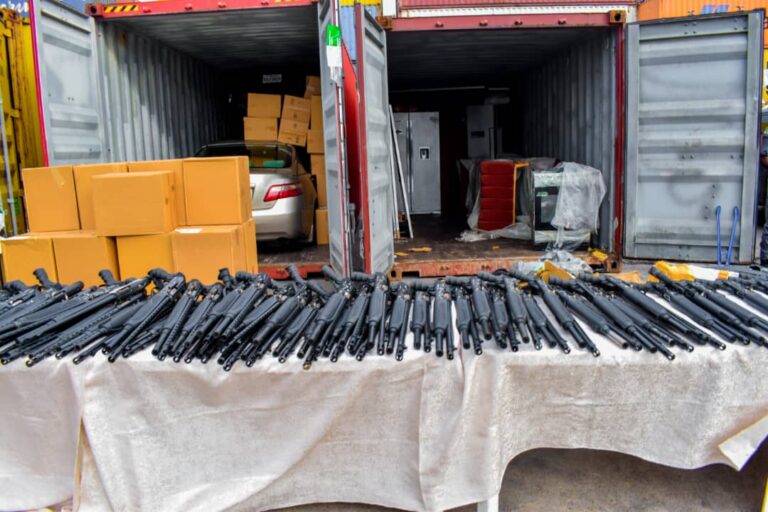
The examination, completed on Sunday, August 9, 2026, revealed 399 fully assembled Jojef pump-action rifles, alongside a substantial quantity of additional firearm components.
The discovery represents a significant breakthrough in the Federal Government’s efforts to prevent the illegal movement of arms through Nigeria’s seaports and borders, particularly at a time when security agencies are stepping up vigilance ahead of another major electoral cycle.
The Comptroller-General of Customs, Adewale Adeniyi, had on Thursday, August 6, disclosed the interception of a container containing crates of knocked-down components suspected to be parts of Jojef pump-action rifles.
What initially appeared to be a consignment of firearm components, however, assumed a more serious dimension after Customs officials completed the coupling and detailed assessment of the seized materials.
The exercise established that the shipment contained 399 fully assembled firearms, in addition to numerous supplementary components.
Among the recovered items were 89 frames, 16 heat shields, 10 trigger pins, three pistons, 25 locking lugs, 80 charging handles, 39 pistol-grip screws, 34 springs, 57 trigger groups, 66 foregrip latches, 45 foregrips or handguards, four pistol grips and five barrels.
Election-Year Security Concern
The seizure has heightened concerns over possible attempts by criminal networks to exploit Nigeria’s ports, borders and airports to move prohibited weapons into the country.
Adeniyi warned that increased political activity ahead of the next election cycle could create additional demand for illicit firearms, making intelligence-led surveillance and tighter border controls imperative.
“We are about entering a major election cycle and we know that by this period, men of the underworld will want to use our borders, our ports, our airports to bring in items like this. We are going to redouble our efforts to ensure that we do not allow them to do so.”
The Customs chief said the Service would intensify surveillance and enforcement operations to frustrate attempts by criminal elements to exploit Nigeria’s international trade corridors.
According to him, the seizure underscores the importance of intelligence-led enforcement, technology-driven surveillance and sustained cooperation among security and law-enforcement agencies.
Beyond Revenue Collection
The seizure also underscores the increasingly broad security responsibilities of the Nigeria Customs Service beyond its traditional mandate of revenue collection and trade facilitation.
As Nigeria continues to confront challenges associated with illicit arms trafficking and violent crime, Customs has become an important component of the country’s border-security architecture.
The Service is collaborating with the National Centre for the Control of Small Arms and Light Weapons (NCCSALW) under the Office of the National Security Adviser (ONSA) to identify, trace and dismantle networks involved in the trafficking of firearms and other prohibited items.
Following the completion of the inventory and assessment, Adeniyi disclosed that the recovered firearms and components were being prepared for handover to the NCCSALW.
The planned transfer is expected to strengthen inter-agency efforts to remove illicit weapons from circulation and support investigations into the networks behind the shipment.
The Bigger Security Picture
For Customs, the Tin Can seizure is more than another successful interception. It is a warning that criminal networks continue to test Nigeria’s border-security systems and exploit legitimate channels of international commerce.
The discovery of hundreds of assembled firearms in a single consignment demonstrates the potential scale of the threat posed by illicit arms trafficking and the importance of maintaining vigilance across the country’s ports and borders.
The NCS said it would continue to deploy intelligence, technology and enhanced surveillance to intercept prohibited consignments while ensuring that legitimate international trade is not unnecessarily disrupted.
The Service also stressed the importance of continued collaboration with sister security agencies in tracing the networks responsible for the shipment, disrupting their operations and ensuring that those behind the attempted arms importation are brought to justice.
The Tin Can seizure therefore sends a clear message: Nigeria’s ports are not open corridors for illicit arms traffickers, and the battle to keep prohibited weapons out of the country is entering a more intensified phase.