

Governor challenges stakeholders to turn Benue’s vast land, agricultural wealth and human capital into businesses, jobs and sustainable prosperity
By Chioma Vivian James
Benue State Governor, Rev. Fr. Dr. Hyacinth Alia, has unveiled an ambitious economic transformation agenda aimed at placing the state on a $5 billion investment pathway by 2035, with job creation, capital formation, infrastructure development and improved living standards at the heart of the plan.
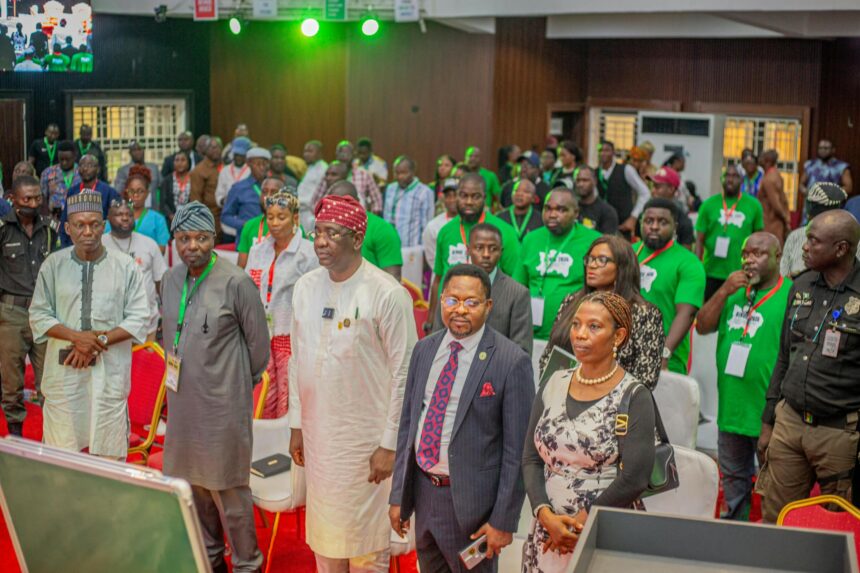
Governor Alia made the call on Monday while declaring open the three-day Benue 2035 Economic Transformation, Capital Formation and Prosperity Summit in Makurdi, organised by the Benue Investment and Property Company Limited (BIPC) in partnership with Hudson Global.
The summit, held at Rev. Father Alia Hall, SEMA, under the theme “From Potential to Prosperity,” brought together government officials, traditional rulers, investors, business leaders, development partners, captains of industry and other stakeholders to chart a new economic direction for the state.
Alia challenged participants to move beyond discussions and develop practical, measurable solutions capable of transforming Benue’s enormous potential into tangible economic opportunities for its people.
According to him, Benue possesses the critical ingredients for prosperity — a large population, fertile land and abundant natural resources — but these advantages would remain meaningless unless deliberately converted into productive investments, businesses, jobs and improved livelihoods.
“This must not be another report that ends up on a shelf,” the governor told participants, urging them to challenge conventional thinking and develop strategies that could produce measurable results.
The governor said his administration was working to create an environment where farmers, entrepreneurs, businesses and families could thrive, identifying security, infrastructure, education, healthcare, investment, employment and strong institutions as critical pillars of the transformation agenda.
He also listed governance, justice, capital formation, fiscal sustainability, agriculture, power, logistics, human capital development, technology, artificial intelligence and productivity among areas requiring urgent attention.
Alia stressed that these sectors were interconnected, noting that insecurity could undermine agricultural production, while inadequate infrastructure and unreliable power could constrain businesses and discourage investment.
He therefore urged stakeholders to focus on solutions that would simultaneously protect lives, unlock investment and create sustainable pathways out of poverty.
A Race Against Population Growth
Earlier, the Group Managing Director and Chief Executive Officer of BIPC, Dr. Raymond Asemakaha, said the summit was conceived as a platform for stakeholders to collectively shape Benue’s economic future.
Asemakaha described the initiative as a conversation about hope, the future of Benue’s children and the prosperity of the state, warning that Benue’s economy must grow faster than its population if the state is to provide opportunities for its growing workforce.
He pointed to the rising number of graduates produced by tertiary institutions, noting that 14,802 graduates emerged in 2024, while the figure rose to 16,200 in 2025.
With an estimated population of about 7.3 million people and more than 34,000 square kilometres of land, much of which remains underutilised, Asemakaha said Benue had both the human and physical resources required for accelerated economic growth.
He explained that BIPC’s responsibility was to provide the platform, while the wider stakeholder community must supply the ideas, investment and commitment required to build a stronger and more competitive state.
Unlocking Billions in Investment
Also speaking, Hudson Global Chief Executive Officer, Prince Tom Isehohi, commended the Alia administration for providing an enabling environment for the initiative and pledged his organisation’s support in mobilising the funding required to advance Benue’s development ambitions.
Isehohi, who shared his personal journey from leaving Nigeria at the age of 17 to working on Wall Street, said his experience had reinforced his belief in the ability of bold ideas and strategic partnerships to transform economies.
He said the SASI model would be deployed during the summit to equip participants with strategic tools and guide the development of an implementable economic blueprint for Benue.
According to him, stakeholders would identify five critical areas with the potential to transform the state into a competitive and prosperous economy.
He further projected that within the next two years, a company capable of generating $2 billion could be established in Benue, underscoring the scale of investment opportunities he believes the state can attract.
Isehohi also expressed confidence in the capacity of the Alia administration and its team to drive the transformation process, while noting that the SASI programme would support the state’s efforts to strengthen security and create an environment conducive to investment.
From Potential to Prosperity
The Benue 2035 Summit comes at a time when the state is seeking to reposition its economy from heavy dependence on its traditional agricultural base toward a broader model driven by investment, industrialisation, technology, infrastructure, human capital and private-sector growth.
For Benue, the ambition is no longer simply to be known as Nigeria’s “Food Basket,” but to translate that agricultural identity into value chains, industries, export opportunities, jobs and wealth creation.
The success of the $5 billion vision, however, will depend on what happens after the summit — particularly the ability of government and private-sector stakeholders to convert ideas into bankable projects, attract capital, improve infrastructure, strengthen security and sustain implementation.
With government, investors, traditional institutions, development partners and business leaders now gathered around a common economic conversation, Benue 2035 represents an attempt to move the state from the language of potential to the reality of prosperity.