

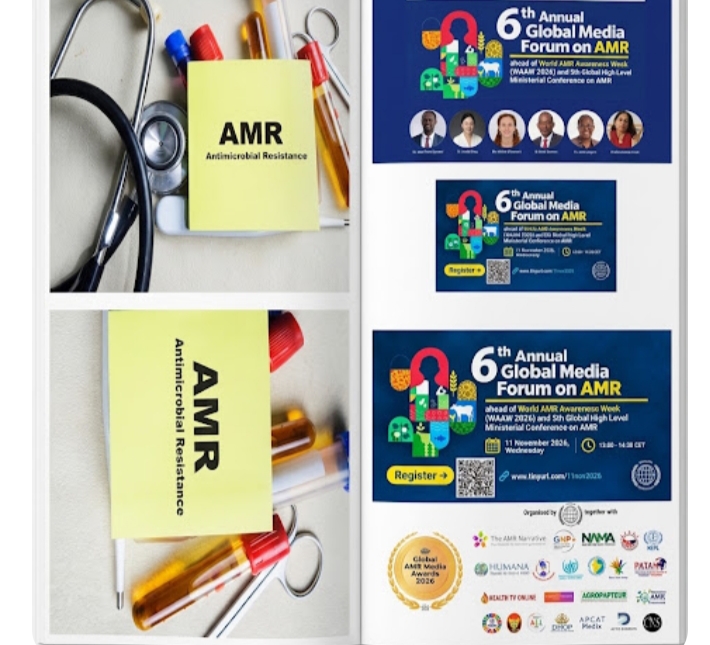

Nigeria records 96 entries as journalists clinch major prizes and special mentions at the Global AMR Media Awards and inaugural Nigeria AMR Media Awards, highlighting the media’s growing role in tackling antimicrobial resistance.
By Chioma Vivian James | Abuja
Nigerian journalists have recorded an impressive performance on the global stage, winning several honours at the Global AMR Media Awards (GAMA) and the inaugural Nigeria AMR Media Awards (NAMA), in recognition of their outstanding contributions to reporting on antimicrobial resistance (AMR).
The awards, announced on November 11, 2026, during the 6th Global Media Forum on AMR, celebrated journalists whose reports have contributed to raising public awareness, promoting responsible antimicrobial use and highlighting the growing threat of drug-resistant infections.
Nigeria’s remarkable outing was underscored by the submission of 96 entries for the two award programmes, representing approximately one-quarter of the total submissions received.
The impressive participation reflects the growing commitment of Nigerian media professionals to specialised health and science journalism, particularly in bringing critical public health issues to the forefront of national and international conversations.
Nigerian Journalists Emerge Winners at Inaugural NAMA Awards
At the maiden Nigeria AMR Media Awards, Kazeem Biriowo of the Nigerian Tribune emerged as the first-prize winner, while Julian Adetinuyo of News Scope Africa secured second place. Mariam Ile-yemi of Premium Times clinched the third position.
Other Nigerian journalists recognised in the special mention category included Folashade Akpan of the News Agency of Nigeria (NAN), Chioma Obinna of Vanguard, Helen Oji Emmanuel of Blueprint, Fatima Saka of DistinctNews, Chinyere Okorafor of Nigeria Health Times, Laide Akinboade of Daily Asset and Odimmegwa John Peter of New Africa Horizon.
The first-, second- and third-prize winners are expected to receive certificates and cash awards, with support from the Art for Health Initiative in Nigeria.
The recognition represents an important step towards encouraging more Nigerian journalists to embrace specialised reporting on antimicrobial resistance and other emerging public health challenges.
Nigerian Reporters Earn Honours at Global AMR Media Awards
Beyond the national awards, Nigerian journalists also distinguished themselves in the Global AMR Media Awards, demonstrating the country’s growing contribution to international efforts to address antimicrobial resistance.
In the category for reporting on the 5th High-Level Ministerial Conference on AMR, Annabel Nwachukwu of the Federal Radio Corporation of Nigeria (FRCN) emerged as the first-prize winner.
Edward Samuel Ikpete of Voice of Nigeria (VON) secured second place, while Doris Obinna of The Sun clinched the third prize. Alice Etuka of The Fact Daily also received a special mention in the category.
In the People’s Reporting category, Isioma Appiah-Yeboah of Clean Beat Radio won first prize, while Princess-Ekwi Ajide of Anambra Broadcasting Service, Smith Nwokocha of Port Harcourt WakaWaka Blog and Chioma Vivian James of Phenomenal people Magazine received special mentions.
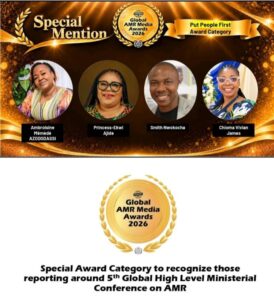
Similarly, Patience Ihejirika of Leadership Newspaper and Benedict Ifeanyi Chukwu of Kaftan TV received special mentions in the Africa category.
The achievements highlight the diversity of Nigerian media voices contributing to global conversations on antimicrobial resistance through investigative reporting, public engagement and evidence-based storytelling.
NAMA: A New Milestone for Health and Science Journalism
Speaking after the announcement, the Founding Chairperson of the Nigeria AMR Media Alliance (NAMA), Ojoma Akor, described the inaugural NAMA Awards as a significant milestone in strengthening health and science journalism in Nigeria.
She observed that antimicrobial resistance had not received sufficient attention in many newsrooms despite its far-reaching implications for public health, healthcare delivery, food security and national development.
According to Akor, the awards go beyond celebrating individual achievements, recognising the power of journalism to make an often-overlooked public health threat visible, translate complex scientific evidence into accessible information, amplify the experiences of affected communities and hold institutions accountable.
She congratulated the winners and nominees, noting that their contributions demonstrate the capacity of Nigerian journalists to influence public understanding and strengthen the country’s response to antimicrobial resistance.
Akor reaffirmed NAMA’s commitment to building journalists’ capacity, encouraging investigative and solutions-oriented reporting, and ensuring that AMR receives sustained attention in Nigeria’s media landscape.
She also called on government agencies, development partners, healthcare professionals, researchers and civil society organisations to deepen their engagement with journalists and support independent, credible and evidence-based reporting on antimicrobial resistance.
Art and Storytelling: Driving Public Understanding of AMR
Also speaking, the Founder of Art for Health Initiative, Chidera Rosecamille Aneke, expressed satisfaction with the organisation’s support for the awards, describing antimicrobial resistance as one of its focal areas.
She explained that the initiative operates at the intersection of storytelling, media and the arts to improve public understanding of critical health issues.
According to her, the support for the awards is intended to encourage innovative, impactful and solutions-driven journalism capable of communicating complex health challenges in ways ordinary audiences can easily understand.
She emphasised the importance of creative storytelling in bridging the gap between scientific knowledge and public action, particularly on issues that directly affect communities.
The partnership, she noted, reflects the need for stronger collaboration between media practitioners and organisations working to promote public health awareness.
GAMA Calls for Stronger Media Engagement
The Chairperson of the Global AMR Media Alliance, Shobha Shukla, congratulated Nigerian journalists for their impressive performance, commending Ojoma Akor for strengthening the Nigerian chapter’s contribution to the global movement against antimicrobial resistance.
Shukla stressed that AMR should not be treated merely as a medical or scientific concern, describing it instead as a broader societal and development challenge requiring coordinated action.
She maintained that the fight against antimicrobial resistance cannot be won through laboratories and hospitals alone but requires an informed public, accountable governments and responsible practices across human, animal and environmental health.
She further urged journalists to move beyond conventional health reporting and take a more active role in building public support for responsible antimicrobial use, stronger health systems and government accountability.
According to her, media engagement is indispensable to the global response to AMR and must remain a sustained priority before the challenge develops into an irreversible crisis.
She also commended the Nigerian media for its contribution to the success of the GAMA awards, encouraging journalists to sustain their efforts towards making antimicrobial resistance a public priority.
Why AMR Reporting Matters
Antimicrobial resistance occurs when bacteria, viruses, fungi and parasites develop the ability to resist medicines that previously treated infections effectively.
The growing threat makes infections increasingly difficult to treat, increases the risk of complications and threatens the safety of routine medical procedures, surgeries and other essential healthcare interventions.
It also poses serious risks to food security, healthcare delivery and global health systems, making it a major concern for governments, healthcare professionals, researchers and communities worldwide.
Nigeria has continued efforts to address the challenge through the implementation of its National Action Plan on AMR, surveillance activities, antimicrobial stewardship, infection prevention and control, as well as collaboration among stakeholders under the One Health approach.
The One Health approach recognises the interconnectedness of human, animal and environmental health and the need for coordinated responses to emerging health threats.
However, significant challenges remain, particularly in public awareness, policy implementation, sustainable financing, research and effective communication.
Against this backdrop, NAMA considers journalists strategic partners in bridging the gap between scientific evidence, government policies and public understanding.
The alliance believes that accurate, accessible and consistent reporting can help communities understand the dangers of inappropriate antimicrobial use, encourage responsible health practices and strengthen public demand for effective policies.
Beyond Awards: A Renewed Commitment to Public Health Reporting
The recognition of Nigerian journalists at both national and international levels represents more than an achievement for individual media professionals. It signals the growing importance of specialised journalism in addressing complex public health challenges.
With Nigeria contributing a significant proportion of entries to the awards, the strong showing provides an opportunity to strengthen the country’s visibility in global health reporting and encourage more journalists to embrace evidence-based, investigative and solutions-oriented storytelling.
The awards also reinforce the need for sustained collaboration among journalists, policymakers, healthcare professionals, researchers, development partners and civil society organisations in confronting antimicrobial resistance.
As the threat continues to challenge healthcare systems and public health security, the responsibility of the media extends beyond reporting statistics and announcing policy decisions.
It involves informing communities, challenging misinformation, amplifying neglected voices, scrutinising institutional responses and demanding accountability from those responsible for protecting public health.
For NAMA, the commitment remains to strengthen journalists’ capacity and ensure that antimicrobial resistance receives the sustained attention it deserves in Nigeria’s media and public health conversations.
Ultimately, the GAMA and NAMA awards have provided a platform for celebrating journalistic excellence while reinforcing a critical message: the fight against antimicrobial resistance requires not only scientists, policymakers and healthcare professionals, but also an informed public and a committed media.