
Musa warns against complacency, demands innovation and professional accountability as Army War College records first female officers and highest allied participation
By Chioma Vivian James | Abuja
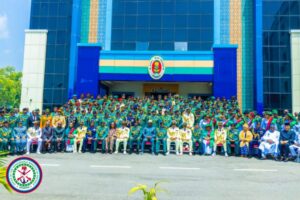
Nigeria’s Minister of Defence, General Christopher Gwabin Musa (rtd.), has challenged 99 graduating officers of the Army War College Nigeria (AWCN) to translate their intensive military training into measurable operational victories, declaring that the country cannot afford to allow insecurity to spill into a third decade.
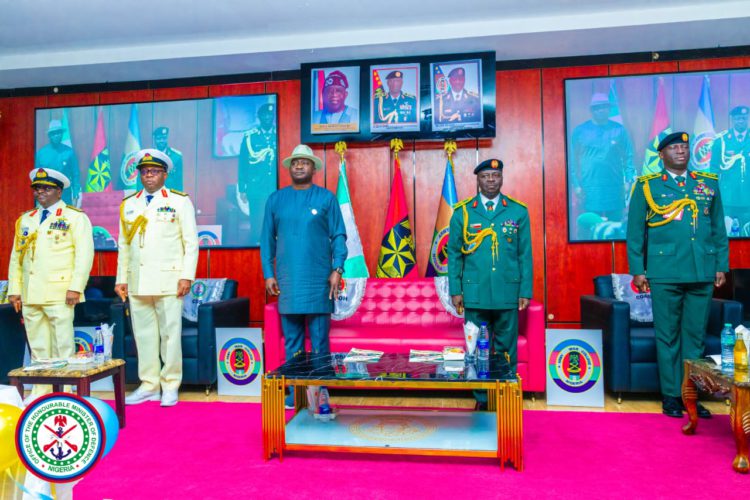
The minister delivered the charge on Friday, October 16, 2026, at the graduation ceremony of Course 10/2026 in Abuja, where he emphasised that the true value of professional military education lies not in certificates or academic distinctions, but in the ability of officers to deliver tangible results against the security threats confronting the nation.
Addressing the graduands, Musa urged them to demonstrate strategic competence, professional discipline and the courage to make a difference in their respective commands, stressing that the country’s security challenges demand decisive leadership and sustained operational effectiveness.
“Go out to the field and make the difference,” the minister charged the officers.
His message reinforced President Bola Ahmed Tinubu’s position at a recent National Security Council meeting that Nigeria must not allow insecurity to extend into a third decade.
The minister maintained that the Armed Forces must convert years of military operations, institutional reforms and professional training into sustainable security gains, particularly amid the complex and evolving threats facing different parts of the country.
 He also reaffirmed the importance of professionalism and constitutional responsibility, urging military personnel to remain committed to protecting the nation’s territorial integrity and safeguarding the lives and property of citizens.
MERIT, INTEGRITY AND PROFESSIONAL EXCELLENCE
Beyond operational effectiveness, Musa emphasised merit-based career progression within the Armed Forces, insisting that dedication, integrity, competence and demonstrable performance must determine advancement to positions of greater responsibility.
He warned against treating promotion as an automatic reward for rank or years of service, stressing that military leadership must be built on proven ability and a genuine commitment to national service.
Citing the career progression of the Chief of Army Staff, Lieutenant General Waidi Shaibu, the minister underscored the importance of hard work and professional excellence in developing a competent military leadership structure.
According to him, officers entrusted with higher responsibilities must possess the character, judgment and operational knowledge required to lead troops and make critical decisions under pressure.
For the 99 graduates, the challenge is therefore not merely to apply the strategic knowledge acquired during their 37-week programme, but also to demonstrate the leadership qualities necessary to achieve results in demanding operational environments.
TECHNOLOGY AND INNOVATION AS FORCE MULTIPLIERS
The Defence Minister also cautioned against the assumption that superior military hardware alone guarantees victory in modern warfare.
Drawing attention to conflicts around the world, he noted that technological adaptation, strategic thinking and innovation have become increasingly important in determining battlefield outcomes.
He urged departments across the Armed Forces to embrace technological advancement and develop practical solutions capable of improving operational effectiveness.
Musa stressed that innovation should not be restricted to engineering and technical personnel, but must become an institutional priority across the military establishment.
The position highlights the need for Nigeria’s Armed Forces to integrate modern equipment, reliable intelligence, professional training and indigenous technological capabilities in confronting increasingly sophisticated security threats.
For the graduating officers, this requires translating classroom knowledge into better operational planning, improved coordination, sound decision-making and the ability to adapt swiftly to changing battlefield conditions.
Developing home-grown military technologies and solutions could also strengthen national defence capabilities and reduce exclusive dependence on imported systems.
MILITARY TASKED WITH PROTECTING ELECTORAL PROCESSES
Beyond the battlefield, Musa charged the Armed Forces to contribute to peaceful, safe and credible electoral processes through effective collaboration with the Independent National Electoral Commission (INEC), the Nigeria Police Force and other relevant security agencies.
He urged military personnel to help protect citizens from intimidation and prevent violent actors from disrupting electoral activities.
The minister’s directive underscores the importance of inter-agency cooperation in safeguarding democratic institutions, particularly during elections when violence, threats and intimidation can undermine public confidence.
Such responsibilities, however, require strict adherence to constitutional provisions, electoral laws and the distinct mandates of the respective security agencies.
ARMY WAR COLLEGE RECORDS HISTORIC MILESTONES
Earlier, the Commandant of the Army War College Nigeria, Major General Umar Alkali, disclosed that Course 10/2026 had completed 37 weeks of intensive professional military education designed to prepare officers for the country’s evolving security challenges.
He announced that the course recorded significant milestones, including the participation of the institution’s first female officers and the highest number of allied military participants since its establishment.
The development represents an important step in expanding professional military education, strengthening international military relationships and promoting the exchange of operational knowledge among participating countries.

Officers from African countries, including South Africa and Cameroon, participated in the programme, reflecting the college’s growing role in fostering regional defence cooperation.
Alkali urged the graduands to uphold professionalism, integrity and sound judgment, emphasising that effective leadership, indigenous technological innovation and inter-agency collaboration remain critical to achieving national security objectives.
His remarks complemented the Defence Minister’s call for practical results, placing responsibility on the newly trained officers to convert their academic and strategic preparation into improved operational capabilities.
RECOGNITION OF COURAGE AND EXCELLENCE
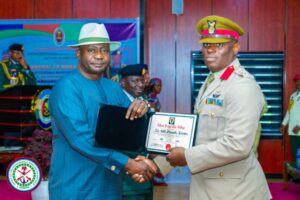
A notable highlight of the ceremony was the presentation of a special souvenir and a N5 million token to a wounded officer among the graduating participants in recognition of his courage and sacrifice.
The gesture acknowledged the personal risks and sacrifices undertaken by military personnel in the discharge of their duties and highlighted the importance of recognising those whose service comes at considerable personal cost.
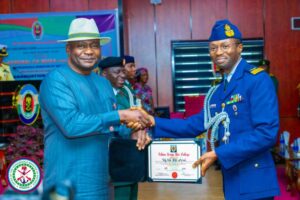
The minister also presented fellowship awards to all 99 graduands, while certificates and other distinctions were awarded to participants.
The Chief of Army Staff presented merit awards to officers who distinguished themselves during the course.
In another significant moment, the graduates were inducted into the Alumni Association of the Army War College Nigeria by its president, Brigadier General O.A. Ogunleye (rtd.).
The ceremony also featured the unveiling and launch of the college’s journal, magazine and books, alongside presentations to Distinguished Eminent Fellows and the presentation of souvenirs to the minister and the special guest of honour.
THE REAL TEST BEGINS AFTER GRADUATION
The graduation of Course 10/2026 marks another milestone in the development of Nigeria’s military leadership, with 99 officers completing an advanced programme designed to strengthen their strategic and operational capabilities.
The record participation of female officers and allied military personnel also signals an expansion of the college’s professional training environment.
However, the ultimate measure of the programme’s success will extend beyond the graduation ceremony. It will depend on the quality of command decisions, the effective use of technology, cooperation among security agencies and the capacity of military formations to protect lives and territory.
Musa’s warning against allowing insecurity to enter a third decade sets an ambitious benchmark for the Armed Forces and the wider national security establishment.
Achieving that objective will require sustained operational effectiveness, credible intelligence, professional accountability and coordinated action across the country’s security institutions.
For the 99 graduands, the message is unmistakable: the real examination begins when they return to their respective commands and must demonstrate that the knowledge acquired at the Army War College can produce measurable improvements in Nigeria’s security landscape.
The ceremony was attended by the Director, Army, Ministry of Defence; senior military officers; members of the diplomatic corps; and other dignitaries.