

Electoral Commission Moves to Strengthen Public Affairs Officers Against Deepfakes, Manipulated Content and Targeted Political Narratives
By Chioma Vivian James
The Independent National Electoral Commission (INEC) has raised the alarm over the growing threat posed by artificial intelligence-driven misinformation and disinformation to Nigeria’s 2027 general elections, warning that the battle for electoral credibility will extend beyond polling units into the country’s rapidly evolving digital information space.
The Commission said the increasing accessibility of generative artificial intelligence has made it cheaper and considerably more difficult to detect manipulated audio, videos and images, while also creating the capacity to develop targeted political narratives for different groups of voters.
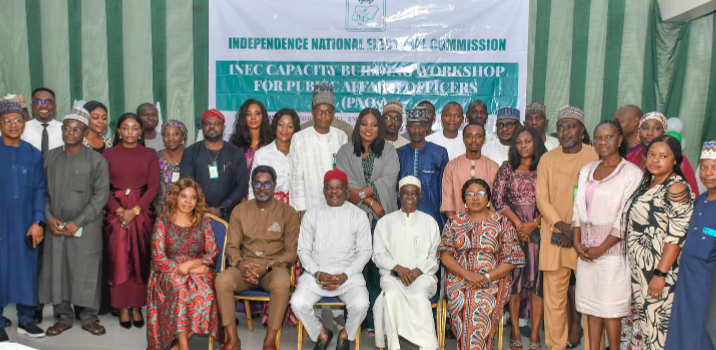
National Commissioner and Chairman of INEC’s Information and Voter Education Committee, Mohammed Kudu Haruna, issued the warning on Monday in Abuja while declaring open a capacity-building workshop for the Commission’s Public Affairs Officers (PAOs) drawn from across the country.
Haruna described the emerging AI threat as “no longer a distant, theoretical risk,” stressing that the development of communication technologies had created a new dimension to electoral information management.
According to him, the danger extends beyond fabricated photographs, videos and audio recordings to the use of AI to generate carefully targeted messages capable of presenting conflicting narratives to different categories of voters.
He noted that such developments could make it increasingly difficult for citizens to distinguish authentic information from fabricated or manipulated content, particularly during an election period when political claims and counterclaims are widespread.
Haruna said the challenge had made it imperative for INEC’s communication officers to develop stronger skills in identifying, verifying and responding to misinformation and disinformation before false narratives gain wider circulation.
He described the Commission’s Public Affairs Officers as “the frontline communicators of INEC in the states,” stressing that the credibility of the Commission’s public communication depends significantly on the accuracy, speed and consistency of information provided by the officers.
The workshop, themed “Strengthening PAOs Capacity for Credible, Verified and Responsible Election Communication Towards 2027,” is designed to equip participants with practical skills in information verification, escalation procedures, consistent messaging and the responsible use of artificial intelligence.
The training also reflects INEC’s broader recognition that election credibility is increasingly connected to the quality of information available to voters.
Haruna recalled the position of INEC Chairman, Prof. Joash Amupitan, who recently emphasised that electoral credibility cannot be assessed only through traditional components such as ballot papers, the Bimodal Voter Accreditation System (BVAS) and result sheets.
According to Haruna, Amupitan stressed that the information environment in which voters receive and assess electoral information is equally important, calling for electoral technology and electoral communication to be treated as interconnected aspects of election management.
Building a Stronger Communication Front
Director of Voter Education and Publicity, Victoria Eta-Messi, said Public Affairs Officers occupy a critical position in shaping Nigerians’ understanding of INEC, its activities and the electoral process.
She noted that the officers operate at the frontline of public communication and are often among the first points of contact between the Commission and citizens seeking clarification on electoral matters.
Eta-Messi said the latest training should be viewed as the beginning of sustained capacity building, disclosing that additional interventions were already at an advanced stage of planning in collaboration with development partners.
She said strengthening the communication capacity of PAOs would help the Commission respond more effectively to emerging information challenges as the 2027 electoral cycle gathers momentum.
Deputy Director, Information and Publicity, Wilfred Ifogah, said participants would also be exposed to the practical applications of AI in communication, alongside the limitations, risks and safeguards associated with the technology.
The officers are expected to strengthen their ability to monitor the information ecosystem, identify emerging misinformation, verify claims and coordinate appropriate responses.
The training will also focus on improving the consistency of INEC press statements, talking points and social media content while strengthening communication between PAOs, heads of department, the Voter Education and Publicity Department and Resident Electoral Commissioners.
Election Battle Moves Into the Digital Space
The Commission’s warning comes as Nigeria approaches the 2027 general elections, with INEC’s current schedule listing the Presidential and National Assembly elections for January 16, 2027, and the Governorship and State House of Assembly elections for February 6, 2027.
With millions of Nigerians increasingly receiving news and political information through social media and other digital platforms, the ability to authenticate information is becoming an important component of election communication.
For INEC, the challenge is therefore not only to conduct elections and communicate official decisions, but also to ensure that voters can distinguish verified information from fabricated content circulating online.
The Commission has repeatedly urged stakeholders, including the media, to strengthen efforts against misinformation and disinformation.
As the 2027 elections draw closer, INEC’s latest initiative signals a renewed emphasis on verification, responsible communication and rapid response as essential tools for protecting public confidence in the electoral process.
The message from the Commission is clear: the integrity of the 2027 elections will be shaped not only by what happens at the polling unit, but also by the information voters encounter before they get there.