
APC South-East Leader Urges Igbo Entrepreneurs to Move Beyond Trading, Tap Investment Incentives and Expand Into Manufacturing and Export
Chioma Vivian James —ABUJA.
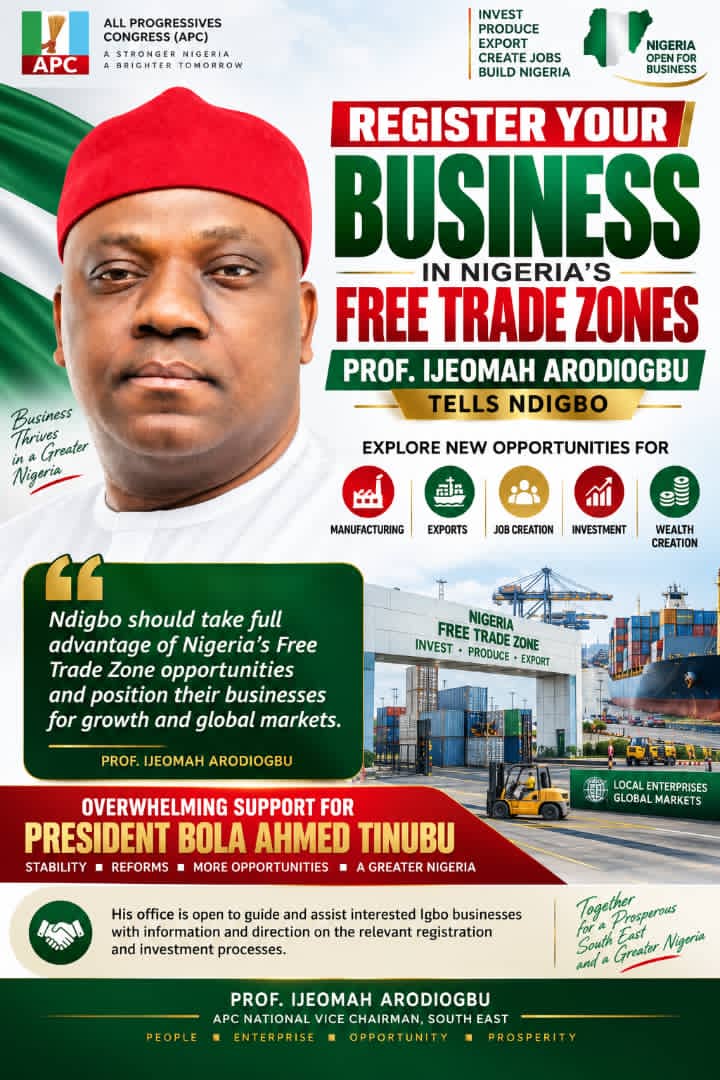
The National Vice Chairman, South-East of the All Progressives Congress (APC), Prof. Ijeomah Arodiogbu, has challenged Ndigbo, particularly entrepreneurs, manufacturers, exporters and young business owners, to take greater advantage of the investment opportunities offered by Nigeria’s Free Trade Zones and Special Economic Zones.
Arodiogbu said increased participation by South-East businesses in the Free Trade Zone system could provide a strategic pathway for Ndigbo to move beyond traditional trading activities and establish stronger footprints in manufacturing, agro-processing, technology, logistics and export-oriented enterprises.
According to him, the opportunities available within the zones could help accelerate industrialisation, expand exports, create jobs, promote technology transfer and generate wealth, while positioning Nigerian businesses more competitively within African and global markets.
The APC South-East leader also urged Ndigbo to support President Bola Ahmed Tinubu’s administration, describing the Federal Government’s economic reforms and investment initiatives as opportunities that entrepreneurs should understand, explore and utilise for business expansion.
He noted that Ndigbo have historically demonstrated a strong culture of enterprise, innovation and commercial resilience, arguing that the same entrepreneurial energy should now be channelled into productive investments capable of strengthening Nigeria’s manufacturing and export capacity.
“I am calling on Ndigbo to look beyond the traditional areas of commerce and take full advantage of the opportunities available in Nigeria’s Free Trade Zones. Our businessmen and women should be among the leading investors, manufacturers and exporters operating within these zones,” Arodiogbu said.
He explained that businesses operating within approved Free Trade Zones can access a business environment designed to encourage investment, production and exports, with incentives applicable under the Free Zone framework and subject to existing laws and regulatory requirements.
He identified potential advantages to include applicable duty and tax incentives, access to export markets, investment facilitation, opportunities for large-scale manufacturing, employment creation, infrastructure within designated zones and integration into regional and international supply chains.
Arodiogbu said the opportunities could be particularly relevant to Igbo entrepreneurs operating in sectors such as manufacturing, agro-processing, pharmaceuticals, textiles, automobile and spare-parts production, technology, logistics, warehousing and other export-oriented industries.
He stressed that the Free Zone system could provide an avenue for Ndigbo to transform their established commercial networks into larger industrial ventures.
“This is an opportunity for Ndigbo to expand from trading into large-scale manufacturing and export. We have the entrepreneurial capacity, the human resources and the investment appetite. What we need is to properly position our businesses and take advantage of the opportunities available to us,” he stated.
APC Office Opens Door to Entrepreneurs
In a significant commitment to supporting prospective investors, Arodiogbu announced that his office is prepared to assist and guide interested Igbo entrepreneurs seeking to understand how they can explore Free Trade Zone opportunities.
He said the office would provide information and guidance on relevant processes, direct businesses towards appropriate government agencies and, where necessary, facilitate connections with relevant institutions and regulatory authorities.
“My office is open to assist Ndigbo who want to explore these opportunities. We are prepared to provide guidance on the processes, direct businesses to the appropriate government agencies and help them understand how they can properly position their investments within the Free Trade Zone framework,” he said.
He, however, advised prospective investors to obtain accurate information from the relevant regulatory authorities and ensure that their businesses comply with all applicable registration, licensing, operational and regulatory requirements.
From Commerce to Industry
Arodiogbu’s call comes against the backdrop of growing efforts to expand Nigeria’s productive capacity and attract investment into sectors capable of generating employment and increasing the country’s export earnings.
He argued that the South-East should not remain at the periphery of Nigeria’s economic transformation, insisting that the region possesses the human capital, entrepreneurial culture and investment potential required to play a leading role in the country’s industrial development.
He therefore encouraged Igbo business owners to explore new markets not only within Nigeria but across Africa and the wider global economy.
According to him, greater investment in manufacturing and export-oriented businesses would strengthen individual enterprises while contributing to job creation, economic growth, regional development and foreign-exchange earnings.
Call for Political Support
The APC leader further appealed to Ndigbo to support President Tinubu’s administration, stressing that political stability and policy continuity are important to the implementation of long-term economic programmes.
He urged the people of the South-East to actively engage with government policies and investment initiatives rather than remain observers of the country’s economic transformation.
“Ndigbo should give President Bola Ahmed Tinubu overwhelming support. We must participate actively in the economic transformation of Nigeria rather than watch from the sidelines. Our businesses, our young people and our communities must be positioned to benefit from the opportunities that are emerging,” Arodiogbu said.
He reaffirmed his commitment to promoting initiatives that would encourage greater participation of South-East entrepreneurs in Nigeria’s investment and industrial development, while urging business owners to embrace productive investment, innovation and export expansion.
For Arodiogbu, the challenge before Ndigbo is no longer simply how to grow businesses, but how to convert their renowned entrepreneurial strength into sustainable industrial enterprises capable of creating jobs, competing globally and contributing meaningfully to Nigeria’s economic future.