

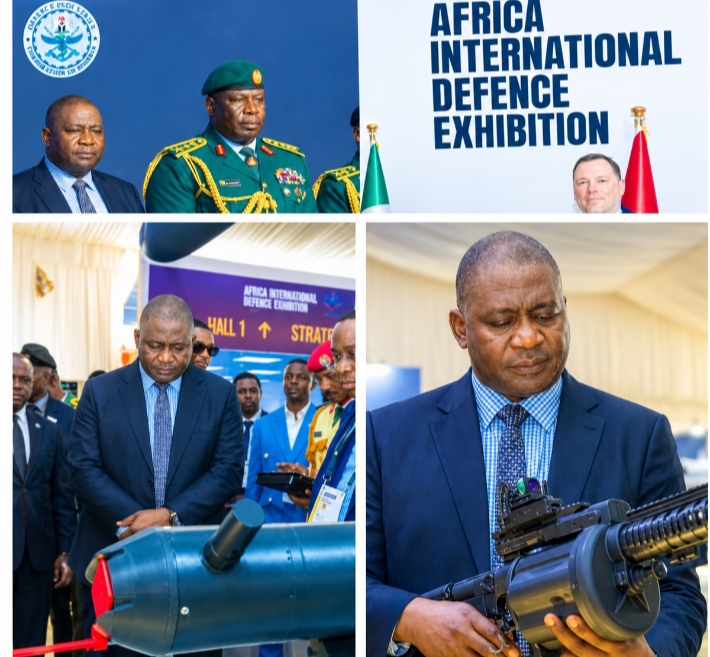
Defence Minister Christopher Musa unveils a one-year production target as CDS Olufemi Oluyede joins African and international stakeholders to advance indigenous defence technology, investment and security cooperation.
By Nonso Okoye | Lagos
Nigeria has intensified efforts to strengthen its indigenous defence industry, with the Federal Government setting a one-year target to accelerate domestic production of military hardware for national use and export to other African countries.
The initiative was unveiled by the Minister of Defence, General Christopher Gwabin Musa (retd.), at the opening of the African International Defence Exhibition (AFRIDEX) 2026 in Lagos on Monday, October 26.
The five-day exhibition, scheduled to run until October 30 at Eko Atlantic City, has attracted defence officials, military institutions, manufacturers, investors and representatives from more than 20 African countries to explore opportunities for technological innovation, industrial development and strategic partnerships.
President Bola Ahmed Tinubu was represented at the opening ceremony by Senate President Godswill Akpabio, while the Chief of Defence Staff, General Olufemi Oluyede, attended the event, underscoring Nigeria’s commitment to strengthening its military capabilities through local production and international cooperation.
Gen. Musa said the Federal Government was determined to develop Nigeria’s capacity to manufacture defence equipment for domestic requirements and supply other African markets.
The proposed shift represents a strategic effort to reduce dependence on imported military hardware, improve operational readiness and build a sustainable defence industrial base capable of responding to the country’s evolving security needs.
For Nigeria, expanding local defence manufacturing could also stimulate industrial growth, create employment opportunities, encourage technology transfer and strengthen the country’s position in Africa’s defence market.
However, achieving the ambitious one-year target will require substantial investment, specialised technical expertise, modern production facilities and effective collaboration between government institutions and private-sector manufacturers.
Details of the specific equipment to be produced, the investment required and the facilities expected to deliver the target were not disclosed at the opening ceremony.
The exhibition provides a platform for stakeholders to examine emerging defence technologies, engage with equipment manufacturers and explore partnerships that could strengthen Africa’s capacity to address complex security challenges.
Gen. Oluyede’s participation highlights the military’s interest in technological advancement and the development of indigenous capabilities to support operational effectiveness.
As security threats increasingly transcend national boundaries, cooperation among African countries and international partners remains essential to improving intelligence-sharing, equipment support and collective preparedness.
AFRIDEX 2026 is expected to facilitate discussions on technology transfer, local manufacturing, investment and collaboration between military institutions and defence industry players.
The Director-General of the Defence Industries Corporation of Nigeria (DICON), Major General B.I. Alaya, also pledged to strengthen the corporation’s capacity, reinforcing the government’s emphasis on domestic defence production.
The Minister of State for Defence, Bello Matawalle, and a United States delegation were also among the participants engaging in discussions during the exhibition.
With representatives from more than 20 African countries in attendance, the event offers Nigeria an opportunity to explore regional markets and develop partnerships that could support the growth of its defence industry.
Nevertheless, participation in the exhibition does not automatically translate into investment commitments, manufacturing agreements or confirmed export contracts.
The success of the initiative will ultimately depend on the government’s ability to translate policy declarations into measurable industrial output, backed by sustainable financing, quality assurance, technical expertise and credible procurement and export arrangements.
As AFRIDEX 2026 progresses, attention will remain on whether Nigeria can turn its ambition of producing more defence equipment locally into a practical and sustainable strategy for national security, industrial development and regional cooperation.