
Salako Identifies Four High-Risk States, Calls for Stronger Surveillance, Regulatory Enforcement and Community Action
By Chioma Vivian James
The Federal Government has unveiled a five-year strategy to combat lead poisoning in Nigeria, with a renewed focus on preventing exposure at its source, strengthening environmental surveillance and protecting vulnerable populations, particularly children and pregnant women.
The initiative comes amid growing concern over the potentially devastating health consequences of lead exposure, which can occur through contaminated soil, polluted dust, unsafe consumer products and hazardous occupational practices.
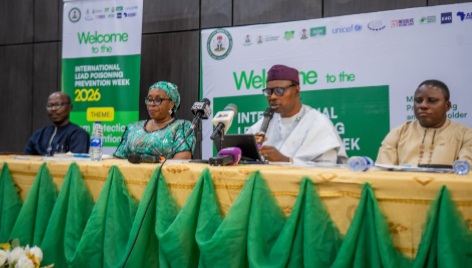
The Minister of State for Health and Social Welfare, Dr Iziaq Adekunle Salako, announced the initiative on Wednesday in Abuja during the 2026 International Lead Poisoning Prevention Week, themed “From Detection to Prevention.”
Salako stressed that Nigeria must move beyond identifying cases of lead poisoning to addressing the environmental, industrial and household conditions that expose people to the toxic metal.
He identified children, pregnant women and women of childbearing age as particularly vulnerable, warning that lead exposure can have lasting consequences for human health and development.
The five-year strategy is designed to strengthen environmental and occupational surveillance, improve laboratory capacity, enhance regulatory enforcement and establish clearer referral pathways for individuals found to have elevated blood lead levels.
It also provides for coordinated action among government agencies and other stakeholders through an Inter-Agency Working Group on Lead Poisoning Prevention and Elimination.
As part of efforts to address the problem at the subnational level, the minister identified Lagos, Ogun, Sokoto and Zamfara as states requiring tailored interventions.
He explained that state-specific action plans would be developed to address local sources of lead contamination and the different pathways through which residents could be exposed.
To translate the broader strategy into practical, measurable outcomes, Salako disclosed that a costed three-year national roadmap was also being developed, with defined timelines and interventions to guide implementation.
The proposed roadmap is expected to provide a framework for turning policy commitments into concrete action, although its impact will depend on effective coordination, adequate funding and sustained enforcement.
Government Seeks Nationwide Collaboration
Beyond government institutions, the minister called on industries, state governments, development partners, civil society organisations, traditional and religious leaders, and the media to support the implementation of the strategy.
He emphasised that preventing lead poisoning requires collective responsibility, particularly in communities where environmental contamination, unsafe industrial practices and inadequate public awareness may increase exposure risks.
“Communities are central to prevention, and our efforts must extend beyond government institutions to all of society,” he said.
Salako also urged Nigerians to adopt practical measures to minimise exposure, including avoiding contaminated soil and dust, using lead-safe products and taking appropriate precautions during battery recycling, painting and other activities that could release lead into the environment.
Workers in high-risk occupations were advised to prevent contaminated clothing and footwear from entering their homes, while households were encouraged to clean floors and children’s play areas using wet-cleaning methods to minimise the spread of lead-contaminated dust.
The minister further recommended diets rich in calcium, iron and vitamin C as part of efforts to reduce the health risks associated with lead exposure.
However, such dietary measures cannot eliminate lead already absorbed into the body or replace the need to identify and remove sources of contamination. Preventing exposure remains the most effective approach.
Implementation Holds the Key
Lead poisoning remains a significant public health concern because exposure may occur without obvious symptoms, while its effects can persist long after contact with the toxic metal.
Children are particularly vulnerable because their developing bodies are more susceptible to lead’s harmful effects. Exposure can affect brain development, learning abilities and behaviour, making prevention essential to safeguarding children’s health and future potential.
For Nigeria, the proposed strategy represents an opportunity to strengthen public health protection through better environmental monitoring, more effective regulation and coordinated action across sectors.
However, the success of the initiative will depend on how quickly the national roadmap is finalised and implemented, whether regulatory agencies can enforce existing safeguards, and how effectively state governments translate national commitments into interventions that reach communities at risk.
Adequate funding, accessible testing services, public education and accountability will also be crucial to ensuring that the strategy delivers tangible results.
Ultimately, protecting Nigerian children from lead poisoning will require more than policy declarations. It will demand sustained action to identify contaminated environments, prevent exposure at its source and ensure that vulnerable communities are not left behind.