

Proposed 30% value-addition bill takes centre stage as industry leaders push to end raw material exports and drive Africa’s manufacturing revolution.
By Chioma Vivian James | Abuja
Director-General of the Raw Materials Research and Development Council (RMRDC), Prof. Nnanyelugo Ike-Muonso, has described President Bola Ahmed Tinubu’s re-election in 2027 as critical to sustaining Nigeria’s industrial transformation, attracting investments and creating jobs through local processing of raw materials.
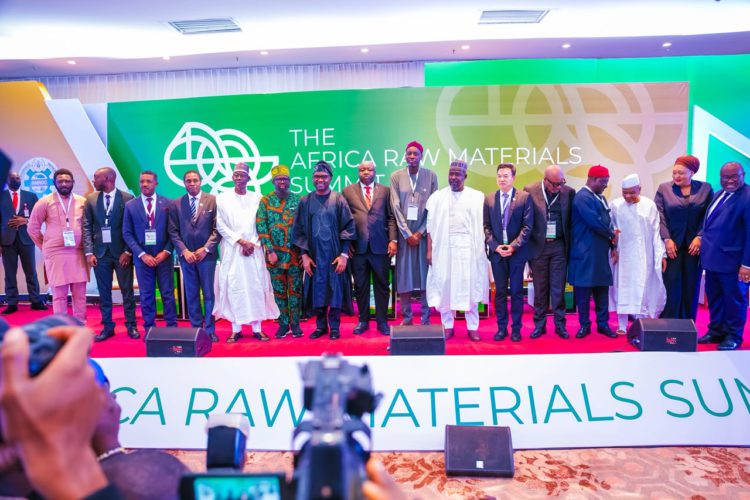
Ike-Muonso stated this while delivering his welcome address at the second Africa Raw Materials Summit 2026 in Abuja on Monday, themed “From African Feedstock to African Factories.”
He stressed that policy continuity would help consolidate industrial reforms, attract investments into processing facilities and manufacturing clusters, and accelerate Nigeria’s transition from exporting unprocessed commodities to producing higher-value finished goods.
He warned that policy uncertainty could discourage investors and delay major industrial projects, including battery-refining complexes and manufacturing facilities.
At the centre of his address was the proposed 30 per cent Raw Materials Value Addition Bill, which seeks to require at least 30 per cent of primary processing and beneficiation to take place locally before raw materials are exported.
 According to Ike-Muonso, the proposed legislation could generate more than 1.2 million high-value jobs, attract foreign direct investment and increase annual non-oil export earnings by over $1.2 billion.
He urged Nigerians to support the administration’s industrial agenda, arguing that sustained policy implementation would help the country realise its manufacturing potential.
Ike-Muonso also identified the African Continental Free Trade Area (AfCFTA), which provides access to a continental market of approximately 1.3 billion people, as an opportunity to expand manufacturing and intra-African trade.
However, he cautioned that Africa could not fully benefit from the agreement without sufficient production capacity to compete with imported finished goods.
The RMRDC boss highlighted the Federal Government’s Nigeria First Policy, introduced in May 2025, and the Nigeria Industrial Policy 2025 as initiatives aimed at strengthening local sourcing, domestic production and industrial competitiveness.
 He further disclosed that more than ₦644.9 billion was mobilised through the Bank of Industry in 2025, supporting the creation and retention of approximately 1.7 million direct and indirect jobs across key sectors.
On the council’s interventions, Ike-Muonso said the RMRDC was translating research into practical industrial solutions through locally developed processing technologies, pilot plants and machinery for mineral beneficiation, lithium concentration, agricultural processing and chemical extraction.
He also highlighted the Nigeria Integrated Information Statistical System for Raw Materials and Products, designed to connect resource owners, researchers, investors and manufacturers through reliable information on raw-material deposits, processing capacity and industrial demand.
He urged African governments, investors and research institutions to move beyond policy declarations by establishing concrete industrial partnerships, regional value chains and investment frameworks.
Enoh Calls for Passage of 30% Value-Addition Bill
The Minister of State for Industry, Trade and Investment, Senator John Enoh, called on lawmakers to support the proposed Raw Materials Value Addition Bill, describing local processing as essential to Africa’s industrial development and economic independence.
Enoh lamented that the continent’s abundant natural resources had not translated into commensurate industrial capacity, employment and economic prosperity because much of its raw materials continued to be exported for processing elsewhere.
He cited lithium deposits in the Democratic Republic of Congo, cocoa production in Ghana and Côte d’Ivoire, and copper deposits in Zambia as examples of resources that could support industrial growth if African countries invested more in processing and manufacturing.
He urged development partners to support processing facilities and industrial infrastructure, stressing that the success of industrial policies should be measured by factories established, investments secured, jobs created and locally manufactured products delivered to the market.
The minister also emphasised the need for stronger implementation frameworks and measurable results to ensure that policy commitments translate into tangible economic benefits.
Sudan Minister Highlights Energy, Refining and Investment
Sudan’s Minister of Mineral Resources, Dr. Dayan Tahar, identified local processing and refining, reliable energy, improved market access and stronger measures against mineral smuggling as priorities for developing Africa’s mineral sector.
He advocated transparent investment procedures, improved economic data and stronger collaboration among governments, universities, industries and regulatory authorities.
Tahar’s position reinforced the summit’s central message that Africa must move beyond extracting and exporting natural resources to building industries that generate employment, technical expertise and greater economic value within the continent.
Automotive, Geological and Industrial Leaders Deliver Goodwill Messages
The Director-General of the National Automotive Design and Development Council, Otunba Oluwemimo Joseph Osanipin, said stronger local sourcing policies could support Nigeria’s automotive industry, particularly electric vehicle production and local vehicle assembly.
He identified batteries, plastics, copper and other industrial materials as important inputs, while calling for stronger collaboration among universities, research institutions and private companies to commercialise locally developed innovations.
Osanipin stressed that access to raw materials alone would not guarantee industrial growth without appropriate standards, processing technologies, investment and effective partnerships.
Similarly, the Director-General of the Nigerian Geological Survey Agency, Prof. Olusegun Ige, called for stronger collaboration between his agency and the Ministry of Solid Minerals Development to improve the identification, assessment and utilisation of Nigeria’s mineral resources.
He emphasised the importance of credible geological information in helping investors assess mineral deposits and make informed decisions on extraction and processing projects.
The Director-General of the Pan-African Alliance for Small and Medium Industries, Dr. Henry Emejeo, described local value addition as fundamental to Africa’s economic independence.
He urged governments to establish clear legal frameworks to discourage the export of unprocessed resources, promote mineral beneficiation and strengthen trade among African economies.
Summit Seeks Continental Industrial Partnerships
Participants at the summit called for stronger political commitment, increased investment in processing infrastructure and regional partnerships to transform Africa’s natural-resource wealth into competitive industries, finished products and sustainable employment.
Proposals included a continental raw-materials value-addition compact, an industrial investment pipeline, a shared raw-materials intelligence platform and regional value chains supported by AfCFTA.
The summit brought together representatives of African governments, the Economic Community of West African States (ECOWAS), development partners, civil society organisations, industry stakeholders and heads of ministries, departments and agencies.
For Nigeria, the proposed 30 per cent value-addition framework represents an opportunity to strengthen domestic manufacturing, expand non-oil exports and create employment. However, achieving the projected 1.2 million jobs and additional $1.2 billion in annual export earnings will depend on effective legislation, reliable electricity, efficient transport, access to finance, appropriate technology and adequate processing capacity.
Ultimately, the success of Africa’s industrial transformation will be measured not simply by the resources extracted and exported, but by the factories established, products manufactured, investments sustained and jobs created across the continent.