
By: Chioma Vivian James
As Nigeria confronts an increasingly complex security environment, President Bola Ahmed Tinubu has unveiled an ambitious military modernisation agenda designed to transform the Nigerian Army into a technologically advanced, combat-ready force equipped to meet both present and future threats.
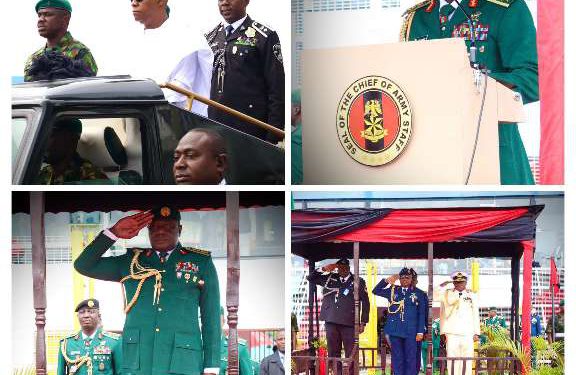
The announcement came during the grand finale of the 2026 Nigerian Army Day Celebration (NADCEL) held in Port Harcourt, Rivers State, where military leaders, policymakers, diplomats and defence experts from across Africa gathered to celebrate the Army’s achievements and chart a new course for national and regional security.
Represented by Vice President Senator Kashim Shettima, President Tinubu reaffirmed his administration’s commitment to strengthening Nigeria’s defence architecture through sustained investment in advanced combat platforms, intelligence capabilities, troop welfare, indigenous defence production and emerging technologies. He emphasized that modern security challenges require innovative solutions, including the integration of Artificial Intelligence and other cutting-edge technologies into military operations.
Describing the Nigerian Army as one of Africa’s most strategic military institutions, the President noted that its contributions to national defence, regional stability and international peacekeeping missions have enhanced Nigeria’s standing on the global stage. He stressed that maintaining this reputation requires continuous investment in modern weapons systems, operational efficiency and personnel development.
“The future of national security lies in preparedness, innovation and adaptability,” the President said, reiterating the Federal Government’s determination to provide the military with the tools and resources necessary to confront evolving threats.
Tinubu also commended the successful hosting of the African Land Forces Forum, describing it as a critical platform for strengthening military diplomacy, fostering regional cooperation and developing collective security solutions to shared challenges across the continent.
The theme of this year’s celebration, “Protecting the Nation and Serving the People: A Way Forward for the Nigerian Army,” reflected the institution’s enduring commitment to safeguarding Nigeria’s sovereignty while deepening public trust and strengthening civil-military relations. The President paid tribute to fallen heroes whose sacrifices helped preserve the nation’s unity and assured their families of the government’s continued support and recognition.
Earlier, the Chief of Army Staff, Lieutenant General Waidi Shaibu, unveiled a far-reaching transformation agenda aimed at repositioning the Nigerian Army for the realities of twenty-first-century warfare. According to him, military effectiveness can no longer be measured solely by battlefield victories but must also be driven by innovation, professionalism, resilience and strategic collaboration.
General Shaibu disclosed that the Army is implementing an extensive capability enhancement programme focused on the acquisition of modern military hardware, renewal of ageing equipment, expansion of operational infrastructure and induction of advanced combat platforms. The initiative, he explained, aligns with the Federal Government’s Renewed Hope Agenda and seeks to build a force capable of addressing both conventional and asymmetric threats.
“The nature of warfare is changing rapidly,” he noted. “Success now depends on technological superiority, intelligence-driven operations and strong partnerships among the military, government institutions, international allies and citizens.”
The Army Chief further emphasized the importance of a whole-of-society approach to national security, calling for stronger cooperation among security agencies, communities and stakeholders to confront emerging threats and safeguard national stability.
Rivers State Governor, Sir Siminalayi Fubara, praised the Nigerian Army for its role in maintaining peace and stability across Rivers State and the Niger Delta region. He observed that improved security has helped protect critical national assets, encourage economic activity and create a more conducive environment for development.
The NADCEL 2026 grand finale showcased the Army’s growing capabilities through an impressive military parade, tactical combat demonstrations, weapons and equipment exhibitions, presentation of the Chief of Army Staff Commendation Awards and a Research and Development Exhibition highlighting advances in indigenous military technology.
The ceremony attracted an array of distinguished guests, including former Nigerian Heads of State Yakubu Gowon and Olusegun Obasanjo, military chiefs from 17 African nations, representatives of the Liberian presidency, members of the National Assembly, state legislators and several former Chiefs of Defence Staff and Chiefs of Army Staff.
Beyond the pageantry and ceremonial displays, NADCEL 2026 delivered a powerful message: Nigeria is positioning its Army for the future. With a renewed focus on technology, innovation, indigenous defence manufacturing and strategic partnerships, the Federal Government is laying the foundation for a modern force capable of protecting national interests, responding to emerging threats and reinforcing Nigeria’s leadership role in regional and international peace support operations.
As the security landscape continues to evolve, the vision unveiled in Port Harcourt signals a decisive shift toward a smarter, stronger and more technologically driven Nigerian Army—one prepared not only to defend the nation today, but to secure its future for generations to come.